Endangered Fin Whale Found on Cruise Ship Bow in Alaska, Investigation Underway
Government regulators and marine scientists are investigating the death of an endangered fin whale that was carried into the Alaska port of Seward on the bow of a cruise ship on Friday.
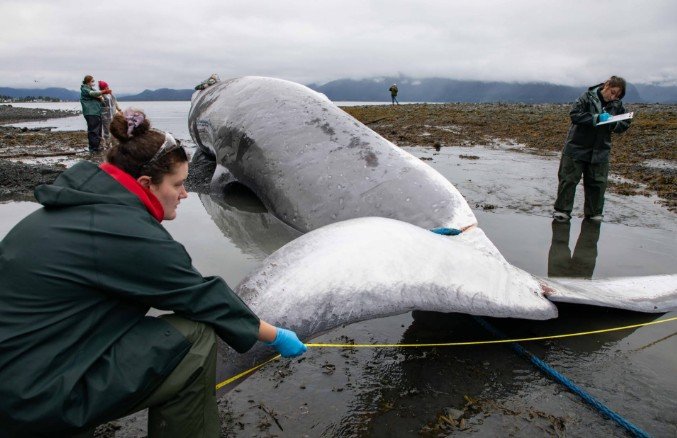
The dead female whale, measuring 61 feet in length and reportedly appearing to be pregnant, was removed by local responders and transported to a nearby beach for further examination, according to the National Oceanic and Atmospheric Administration (NOAA).
NOAA Fisheries and the Alaska SeaLife Center are jointly conducting a necropsy to determine the cause of death and gather additional information about the incident.
While NOAA did not identify the vessel involved, the only cruise ship scheduled to arrive in Seward on Friday was the Ovation of the Seas, operated by Royal Caribbean Cruise Line.
Royal Caribbean later confirmed that one of its ships had struck the whale while traveling to Seward.
“We are saddened to hear that one of our ships struck a whale while on its way to Seward. We take any impact to marine ecosystems very seriously. The ship immediately reported the incident to the proper authorities. We are cooperating fully with NOAA and are awaiting the necropsy results,” a company spokesperson said.
The incident has renewed attention on the threat vessel collisions pose to whale populations. Fin whales are listed as endangered under the U.S. Endangered Species Act and are the world’s second-largest whale species after blue whales. NOAA identifies ship strikes as one of the leading threats to their recovery.
Whale-vessel collisions have been documented in Alaska for decades. A NOAA report published in 2012 recorded 108 reported whale-vessel collisions in Alaska between 1978 and 2011. Nearly one-quarter of those incidents resulted in the death of the whale. The report included collisions involving cruise ships, including a 2010 incident involving a Princess Cruises vessel.
More recent data also highlights the scale of the issue. A 2024 NOAA report examining human-caused, non-hunting deaths of Alaska marine mammals recorded 41 probable humpback whale deaths between 2018 and 2022, along with fatalities involving several other whale species. According to the report, more than two dozen whales were likely killed by ship strikes during that period.
Marine conservation advocate Rick Steiner said the Seward incident further demonstrates the need for vessel speed restrictions in important whale habitats throughout Alaska.
Steiner, a retired University of Alaska marine biologist and head of the environmental organization Oasis Earth, has long campaigned for ship speed limits in areas where whale populations overlap with heavy maritime traffic.
He noted that mandatory speed restrictions have been implemented along parts of the U.S. East Coast to help protect endangered Atlantic right whales, while voluntary speed reduction measures have been adopted in some California waters.
According to Steiner, reducing vessel speeds significantly lowers the risk of fatal whale strikes. He added that whales found pinned to the bows of ships likely represent only a small portion of total whale-vessel collisions occurring at sea.
Steiner and other stakeholders, including the Prince William Sound Regional Citizens Advisory Council, have advocated for speed limits in areas such as Unimak Pass, Icy Strait, Prince William Sound, and Resurrection Bay, where whale activity and commercial vessel traffic frequently intersect.
He has proposed speed limits of 10 knots during daylight hours and 8 knots during periods of reduced visibility. Those speeds are considerably lower than the typical operating speeds of many vessels, including cruise ships, which often travel at 20 to 22 knots, and oil tankers, which commonly operate at 15 to 17 knots.
However, regulators and industry groups have not yet agreed to adopt such measures, either as mandatory requirements or voluntary guidelines.
Steiner welcomed Royal Caribbean’s acknowledgment of the incident but said the focus should remain on preventing future whale strikes.
“But what are they going to do about it is the question,” Steiner said. “If Royal Caribbean is genuinely contrite and wants to do something about it, we know what that is.”
Read: Humpback Whale ‘Timmy’ Brought Ashore in Denmark after Months-Long Baltic Sea Rescue Effort
The investigation into the whale’s death remains ongoing as scientists work to determine the circumstances surrounding the collision and assess its impact on marine wildlife conservation efforts in Alaska.