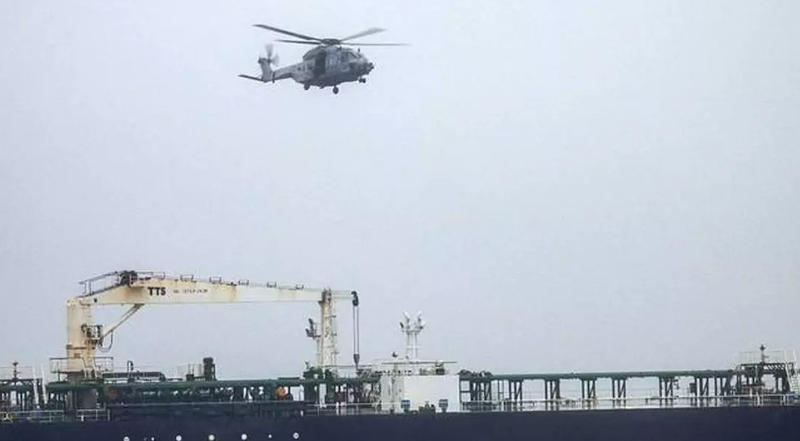
French Navy, Supported by UK, Intercepts Russian-Linked Oil Tanker Suspected of Sanctions Evasion
The French Navy, with operational support from the United Kingdom, has intercepted an oil tanker suspected of belonging to Russia’s so-called “shadow fleet,” a network of vessels allegedly used to circumvent international sanctions imposed on Moscow.
French President Emmanuel Macron confirmed on Monday that the tanker Tagor was boarded by French authorities on Sunday in the Atlantic Ocean as part of ongoing efforts to enforce maritime sanctions and strengthen international shipping compliance.
In a statement posted on X, Macron said it was unacceptable for vessels to bypass international sanctions, violate maritime regulations, and contribute to financing Russia’s war against Ukraine.
“These ships, that don’t respect the most elementary rules of maritime navigation, are also a threat to the environment and everyone’s security,” Macron stated.
According to French authorities, the tanker had departed from Murmansk, a major Russian Arctic port, and was reportedly bound for Limbe, a coastal city in western Cameroon.
The Atlantic Maritime Prefecture said the vessel was sailing under a Cameroonian flag that authorities believe was being used improperly. Officials diverted the tanker to verify the legitimacy of its flag registration and compliance with international maritime law.
Guillaume Le Rasle, spokesperson for the Atlantic Maritime Prefecture, said the vessel was already known to authorities and had been under close monitoring.
“It is a vessel that was known and tracked,” Le Rasle told AFP. “The decision to divert it was taken Sunday evening. The objective of the diversion is to verify the validity of its flag.”
Authorities reported that the tanker was almost empty when boarding operations were conducted.
MarineTraffic vessel-tracking data indicated that the last Automatic Identification System (AIS) signal transmitted by the Tagor, approximately one week earlier, showed the vessel operating off the Norwegian coast while displaying a Madagascan flag, highlighting a history of multiple flag changes.
French authorities stated that the interception occurred more than 400 nautical miles west of Brittany in the Atlantic Ocean.
Increased Scrutiny of Russia’s Shadow Fleet
Oil exports remain a critical source of revenue for Russia and are considered vital in offsetting the costs associated with the ongoing conflict in Ukraine.
Western governments believe Russia has increasingly relied on a large fleet of tankers operating outside conventional maritime compliance frameworks to continue transporting crude oil and petroleum products despite sanctions.
France, alongside other European and allied nations, has intensified efforts to identify, inspect, and detain vessels suspected of sanctions evasion, maritime fraud, and unsafe shipping practices.
Since September, French authorities have boarded three other vessels linked to suspected sanctions violations. Those ships were subsequently released after financial penalties were paid by their owners.
In September, the French Navy boarded the tanker Boracay, which claimed registration in Benin. Its Chinese captain was later tried in absentia, and a French court issued an arrest warrant and imposed a one-year prison sentence in March.
French maritime enforcement agencies also impounded another suspected Russian-linked tanker, Grinch, in January. In March, authorities detained Deyna, a vessel that had departed Murmansk while operating under a Mozambican flag, in Marseille.
Read More: Engine Room Fire on Oil Tanker at Chattogram Port Outer Anchorage Brought Under Control
In April, France announced plans to strengthen maritime enforcement by doubling penalties against vessels that fail to fly a recognized national flag or refuse to comply with maritime inspections.
Several Western nations have imposed sanctions on Russian vessels following Russia’s full-scale invasion of Ukraine in 2022.
Russian President Vladimir Putin has previously criticized the detention of Russia-linked ships, describing such actions as “piracy.”