Maersk Completes Record 5,000-Tonne Ethanol Bunkering in Singapore
Maersk has completed a record-breaking 5,000-tonne bioethanol bunkering operation at the Port of Singapore, marking a significant technical milestone for alternative marine fuels and the decarbonisation of global shipping. Conducted on 18 October 2026 aboard the container vessel Maersk Halifax, the operation demonstrated the potential to expand ethanol as a marine fuel while maintaining normal port activities.
The operation was the first ethanol bunkering at Singapore’s Pasir Panjang terminal and the first for a Maersk vessel retrofitted to operate on ethanol. It also represented the largest ethanol bunkering volume globally to date. From an industry perspective, the milestone provides practical evidence on fuel-handling procedures and existing infrastructure compatibility, helping inform future investment in low-carbon shipping and alternative-fuel supply systems.

Singapore Tests Ethanol Bunkering Infrastructure
The 5,000 tonnes of ISCC-certified bioethanol were supplied through a mass flow meter (MFM) while container operations continued simultaneously, under a process known as simultaneous operations (SIMOPS).
Singapore’s Maritime and Port Authority (MPA) said the operation would generate practical experience in handling ethanol and assess whether existing mass flow meter infrastructure could support ethanol bunkering.
The findings will also inform the review of Singapore’s existing methanol bunkering standards, known as Technical Reference 129, and help authorities assess how these requirements could be adapted for ethanol.
Local bunker supplier Golden Island conducted the operation, with the fuel delivered by chemical tanker M.T. Golden Centaurus. The operation coincided with the Singapore International Bunkering Conference (SIBCON), a major industry event focused on marine fuel supply and bunkering developments.
Maersk Advances its Multi-Fuel Decarbonisation Strategy
Ethanol is gaining attention as a potential transition fuel because of its established production and distribution networks, global availability and compatibility with alcohol-fuel engine technologies. When produced through certified low-carbon pathways, it can reduce greenhouse gas emissions compared with conventional marine fuels.
Emma Mazhari, Head of Energy Markets at Maersk, said the energy transition requires the industry to explore and scale solutions capable of delivering practical results. She added that Maersk continues to pursue a multi-fuel strategy because no single fuel pathway can decarbonise global shipping independently.
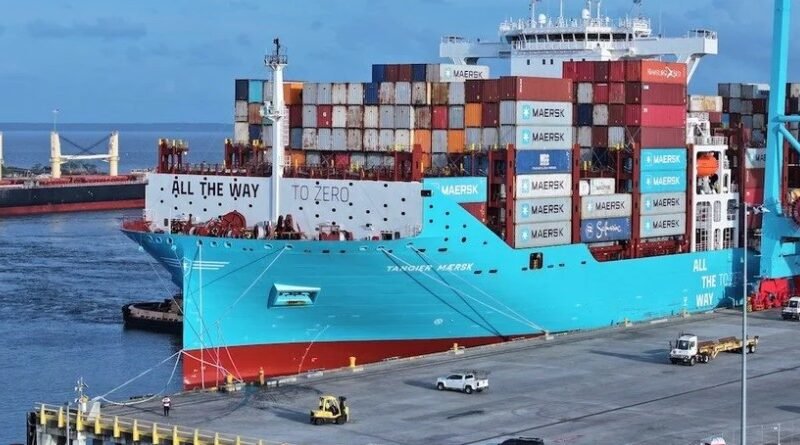
Earlier in 2026, Maersk conducted successful ethanol trials aboard its dual-fuel vessels Laura Maersk, Antonia Maersk and Tangier Maersk. The latest bunkering operation extends the company’s work from vessel-level trials to the practical challenges of supplying larger quantities of alternative fuel within an active commercial port.
Vale Expands Investment in Ethanol-Capable Ships
Interest in ethanol-powered shipping is also influencing new vessel investment. In October 2026, Brazil-based mining company Vale announced a long-term charter agreement with MOL Ocean Bulk for two 210,000-deadweight-tonne (DWT) vessels. Scheduled for delivery in 2030, the ships will be capable of operating on fuel oil, methanol and ethanol.
Vale’s Shipping Director, Rodrigo Bermelho, said designing and building new vessels provides an opportunity to integrate technological advances into the company’s decarbonisation programme. He added that fuel flexibility would help Vale respond to regulatory and market uncertainty while retaining different strategic options.
Earlier in 2026, Vale announced plans to charter two 325,000-DWT dual-fuel dry bulk carriers from China’s Shandong Shipping. These vessels are designed to operate on ethanol and are expected to become the first deep-sea vessels capable of using the fuel when they enter service in 2029.
The announcement accompanied a larger order for 10 ore carriers of the same 325,000-DWT class. Maritime research firm Drewry said the plans represented Vale’s return to ship ownership and aligned with its strategy of reducing transportation costs through larger, more efficient ore carriers.
The strategy also reflects the competitive pressures facing major iron ore exporters. BHP and Rio Tinto benefit from shorter shipping routes between Western Australia and major markets in China and elsewhere in East Asia, making logistics efficiency an important factor in global iron ore trade.
Ethanol and Methanol: Opportunities for Marine Fuel Transition
Ethanol is already an established transportation fuel in several countries. According to Brazil’s Energy Research Office (EPE), Brazilian ethanol production is approximately 35.7 billion litres.
The fuel shares characteristics with methanol, potentially allowing the maritime industry to build on existing investment in alcohol-fuel engines, bunkering infrastructure and technical expertise. Classification society DNV has highlighted these similarities as an opportunity to support the development of alternative marine fuels.
However, wider adoption will depend on commercial viability and the ability to establish reliable fuel supply chains. Shipowners and operators must assess fuel costs, availability, infrastructure requirements and compatibility with vessel technology before committing to large-scale deployment.
Singapore’s operation provides an important practical step in that assessment by testing the handling of a substantial ethanol volume through existing port infrastructure. Its results could help clarify the technical requirements for expanding ethanol bunkering beyond demonstration projects.
Industry Outlook: Can Ethanol Become a Scalable Shipping Fuel?
The record operation highlights a central challenge in maritime decarbonisation: a viable alternative fuel must be supported by both suitable vessel technology and a dependable bunkering network.
Ethanol’s established production base offers a potential supply advantage, while dual-fuel vessels provide operators with greater flexibility during the transition to lower-carbon shipping. Nevertheless, the environmental benefits depend on how the fuel is produced, and its commercial prospects will be shaped by supply costs, emissions performance, safety requirements and port regulations.
For Singapore, the operation offers an opportunity to develop evidence-based standards for ethanol bunkering. For Maersk and other shipowners, it provides operational experience relevant to the broader challenge of integrating alternative fuels into global shipping networks.
Read:Corn Ethanol Could Open New Marine Fuel Market for Shipping
The milestone does not establish ethanol as a universal replacement for conventional marine fuels. Instead, it demonstrates how large-scale bunkering trials, adaptable infrastructure and multi-fuel vessel designs can contribute to the search for commercially viable pathways to reduce shipping emissions.