Op-Ed: Oil Politics and Maritime Trade: Is the Gulf Entering a New Phase?
For the better part of seven decades, the Persian Gulf has operated under a crude but functional logic: oil flows out, dollars flow in, and the security of the sea lanes is guaranteed , however reluctantly , by American naval primacy. That logic is now fracturing under the weight of simultaneous pressures that no single previous crisis has combined: a proxy war that turned the Red Sea into a free-fire zone, a direct US-Israeli military confrontation with Iran, and the first effective closure of the Strait of Hormuz since the tanker wars of the 1980s. The Gulf is not merely experiencing disruption. It appears to be entering a structurally new phase.
This analysis draws on data published since the onset of the Red Sea crisis in late 2023 and through the Hormuz closure of early 2026, and attempts to place the current moment within the longer arc of Gulf energy geopolitics. The central argument is this: what began as a tactical maritime harassment campaign by the Houthis has cascaded into a systemic shock that is redrawing trade routes, stress-testing energy security architecture, and forcing a reckoning with the fragility of the hydrocarbon corridors that underpin the global economy.
The Arithmetic of Dependence
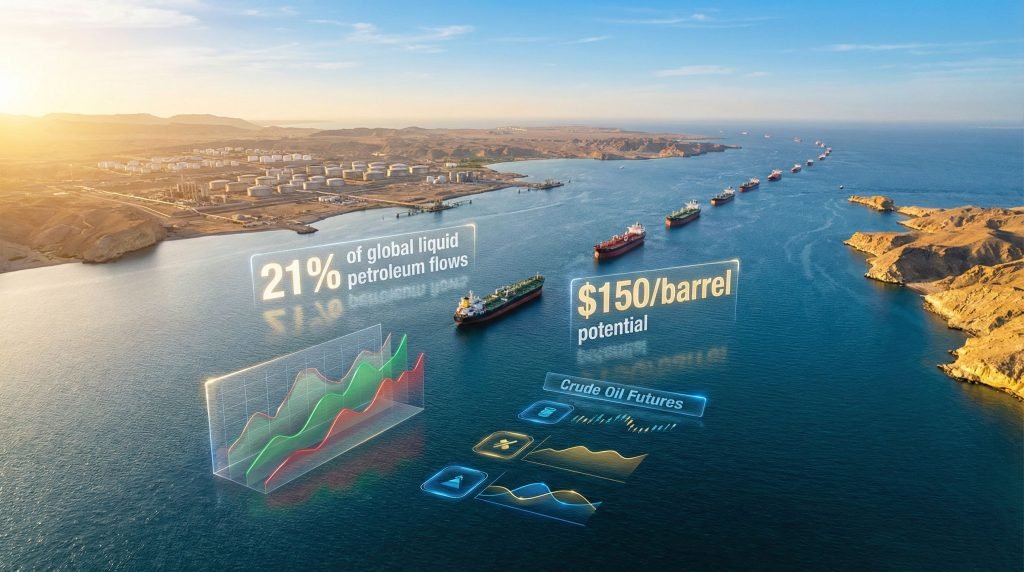
Any honest assessment of the Gulf’s maritime significance must begin with the numbers, and the numbers are staggering. [1] In calendar year 2024, approximately 20 million barrels per day of oil , crude and petroleum products combined , moved through the Strait of Hormuz. Those volumes represented approximately 27% of global maritime oil trade and roughly 20% of world petroleum liquids consumption. To put that in human terms: one in every five barrels of oil burned anywhere on Earth in 2024 passed through a waterway just 34 kilometres wide at its narrowest point.
The strait is not merely an oil pipeline. Around one-fifth of global liquefied natural gas trade also transits Hormuz, primarily from Qatar, where [6] about 93% of LNG exports pass through this single corridor. For LNG, unlike crude oil, there are no alternative pipelines, no emergency bypass routes. The gas either passes through the strait or it does not reach market.
Saudi Arabia, the single largest exporter, accounts for the biggest national share of Hormuz flows: [1] in 2024, Saudi crude and condensate exports through the strait amounted to 5.5 million barrels per day, or 38% of total Hormuz crude flows. The kingdom does possess a partial bypass , the East-West pipeline running to the Red Sea port of Yanbu, nominally rated at 5 million b/d (temporarily expanded to 7 million b/d in 2019) , but it has been stressed by the very disruptions it was meant to relieve. The UAE operates a parallel 1.8 million b/d bypass pipeline to Fujairah, but increased day-to-day usage has limited surplus capacity precisely when it is needed most.
“Traffic through the Strait has been essentially halted by the conflict, putting pressure on the trade of a wide range of energy products.”
International Energy Agency, May 2026The strategic reserve of spare bypass capacity , totalling perhaps 3.5 to 5.5 million b/d between Saudi Arabia and the UAE , sounds substantial until one calculates what it cannot cover: roughly 15 million b/d of crude and product flows have no alternative routing whatsoever. Iraq, Kuwait, Qatar, Bahrain, and Iran have no bypass options at all. [6] They rely entirely on the Strait to deliver the vast majority of their oil exports.
Phase One: The Houthi Campaign and the Red Sea Fracture (2023–2025)
The current crisis did not begin with Iran’s closure of the Strait. It began, more modestly, with a missile fired at a commercial vessel in the southern Red Sea on 19 November 2023. That first Houthi attack , ostensibly in solidarity with Gaza , would initiate the most sustained campaign of maritime disruption since the Second World War.
The scale of the disruption can be measured in several ways. The most striking is the Suez Canal traffic data: [11] transits collapsed from 2,068 vessels in November 2023 to approximately 877 in October 2024 , a 58% decline. But perhaps more significant than the immediate disruption is the persistence of its effects. Even as Houthi attacks on commercial vessels declined sharply in 2025 , [20] only 7 attacks on commercial ships that year, compared with 150 in 2024 , shipping traffic did not recover. The psychological and actuarial recalibration of maritime risk had already occurred. War risk insurance premiums, rerouting protocols, and carrier routing algorithms had baked in a new normal.
[14] Freight rates between Shanghai and Rotterdam remained 80% higher in January–October 2025 compared to the same period in 2023, even as attack rates fell. The Houthis had, in effect, permanently raised the baseline cost of shipping between Asia and Europe , not through continuous violence, but through the structural adaptation that their initial campaign forced upon the global carrier fleet. This is an important lesson for geopolitical analysis: the cost of disruption outlasts the disruption itself.
The financial calculus of the Red Sea crisis extends beyond freight rates. [16] The Houthis were reportedly blocking an estimated $10 billion in cargo each day at the campaign’s peak. Egypt, whose Suez Canal revenues declined by more than 50% in 2024, suffered a compound fiscal shock at precisely the moment its public finances were already under strain. Eilat declared bankruptcy in July 2024. Saudi Arabia’s Red Sea ports , Jeddah Islamic Port and King Abdullah Port , experienced a roughly 45% decline in vessel activity between 2023 and 2025, with King Abdullah’s throughput plunging by over 80% in 2024.
Phase Two: Escalation to Hormuz (2026)
The Red Sea crisis was, viewed in retrospect, a prelude. The second, more consequential phase of Gulf maritime disruption began on 28 February 2026, when US and Israeli forces launched direct military operations against Iran. Tehran’s response was to deploy its most potent asymmetric tool: the closure of the Strait of Hormuz.
[2] The Iranian Revolutionary Guard Corps (IRGC) issued warnings forbidding passage through the strait, boarded and attacked merchant ships, and laid sea mines in the strait. Tanker traffic, which had averaged approximately 20 million barrels per day in 2024, dropped first by about 70% and then to near-zero. [4] By March 8, the UK Maritime Trade Operations Centre reported 10 attacks on ships; by March 27, the IRGC announced that the strait was closed to any vessel going “to and from” the ports of the US, Israel, and their allies.
The price response was immediate and historic. [2] Brent crude surpassed $100 per barrel on 8 March 2026 for the first time in four years, rising to $126 per barrel at its peak , the largest ever monthly increase in oil prices on record. Crude oil and fertiliser prices spiked sharply, while natural gas prices in Europe and Asia rose sharply and remained elevated.
The downstream effects spread rapidly across commodity markets. [6] The IEA reported that nearly 3 million b/d of refining capacity in the Persian Gulf shut down due to attacks and lack of viable export outlets. Gulf producers had exported 3.3 million b/d of refined petroleum products and 1.5 million b/d of liquefied petroleum gas in 2025 , flows now essentially cut off. For India, which takes over 45% of Middle East Gulf LPG exports, and where almost 90% of LPG uptake goes to domestic heating and cooking, the supply shock was near-immediate and directly felt at the household level.
[8] Data from Starboard Maritime Intelligence showed that of the 187 vessels that successfully transited the strait since March 4 , a fraction of normal traffic , over half were operated by shipping companies located in just four countries. About 20,000 mariners and 2,000 ships were stranded in the Persian Gulf.
“Brent crude surpassed $100 per barrel on 8 March 2026 for the first time in four years, rising to $126 at its peak , the largest ever monthly increase in oil prices in recorded history.”
IEA, Oil Market Report, March 2026The Asian Exposure Calculus
It is impossible to understand the geopolitical significance of Gulf maritime trade without focusing on Asia, and specifically on the concentration of risk among a small number of large economies. [2] In 2024, an estimated 84% of crude oil and condensate shipments through the Strait of Hormuz were destined for Asian markets, with China receiving a third of its oil via the strait.
[10] The Gulf Trade Exposure Index, compiled by The National using 2024 BACI trade data, illustrates the asymmetric vulnerability among Asian importers. China spent $174.84 billion on Gulf fuel imports in 2024, making it the largest buyer by value. South Korea and Japan import vast volumes of oil and gas, making them among the most exposed economies when supply is disrupted. The index’s Marimekko analysis , mapping both the share of Gulf-sourced imports and the total value of those imports , reveals that the major Asian economies are simultaneously the most dependent and the least diversified.
The US position is, by comparison, relatively insulated. [7] Imports from the Middle East Gulf region made up just 8% of the 6.2 million b/d of US crude oil imports in 2025 , far less than Canada or Mexico, and buffered by domestic shale production. But American insulation does not translate into indifference, and Trump’s March 2026 announcement ordering US political risk insurance for “ALL Maritime Trade” through the DFC underscored that Washington understands the systemic implications even where its own refineries are not immediately threatened.
The Structural Question: Beyond Crisis Management
Every major Gulf maritime disruption of the past four decades has been managed, eventually, through some combination of military deterrence, diplomatic settlement, and market adaptation. The 1984–1988 Tanker War , in which both Iran and Iraq attacked hundreds of vessels , was resolved by the combination of US naval escort (Operation Earnest Will), war-weariness, and the ceasefire that ended the Iran-Iraq War. The Kuwaiti oil fires of 1991 were extinguished. The 2019 Abqaiq attacks were absorbed by Saudi spare capacity. The 2021 Suez Canal blockage lasted six days.
But there are reasons to think the current phase may have different structural characteristics , features that complicate the standard recovery narrative.
Structural shift 01 , The Insurance Architecture Has Changed
The Houthi campaign did something unprecedented: it demonstrated, over 18 months of sustained operations, that a non-state actor with Iranian material support could durably disrupt a major global shipping lane against the combined opposition of US, UK, EU, and regional naval forces. [16] War risk premiums reached around 1% of cargo value following the July 2025 commercial container attacks , a level not seen since the 2019 Gulf of Oman incidents , and the psychological threshold for insuring Gulf transits has been permanently raised. Even in the absence of attacks, the actuarial model has shifted.
Structural shift 02 , The Cape of Good Hope Has Been Legitimised
The massive rerouting of cargo around southern Africa has revealed something important: the global container shipping system is more adaptable than its critics suggested, but that adaptation is not free and it is not reversible simply because the threat recedes. [14] Routes connecting East Asia to European ports accounted for nearly 25% of global container ship capacity in November 2025, compared with just 21% in May 2023. The economics of cape routing , longer but more predictable and insurable , may retain appeal even after Hormuz reopens.
Structural shift 03 , The Multipolar Security Vacuum
The Gulf’s maritime security has historically rested on a de facto American guarantee backed by naval primacy. The 2026 crisis has exposed the limits of that guarantee. [8] Commercial traffic through the strait has not recovered despite significant naval presence. The US, while announcing political risk insurance and discussing naval escort, has not succeeded in reopening the strait unilaterally. Russia and China , both significant importers of Gulf energy , have different threat calculations and have not participated in coalition maritime security efforts. The multilateral architecture needed to sustain freedom of navigation in a genuinely contested strait does not currently exist.
Structural shift 04 , The Accelerant Effect on Energy Transition
Every oil price shock since 1973 has accelerated, at least temporarily, investment in alternative energy sources. The current crisis is occurring in an environment where renewable energy costs have fallen dramatically and where political pressure on energy security grounds , distinct from climate grounds , is now being deployed by governments across Asia and Europe. The near-term effect of the Hormuz closure has been inflationary. The medium-term effect may be to pull forward the diversification timeline of major Asian importers , particularly South Korea and Japan, whose Hormuz dependency the data show to be extreme.
The Opinion: A Phase Change, Not a Crisis Cycle
The analytical temptation, when confronted with Gulf maritime disruption, is to reach for the historical precedent , to note that the strait has been threatened before, that oil markets have recovered, that diplomacy eventually prevails. This temptation should be resisted, not because history is irrelevant, but because the specific constellation of factors currently converging is genuinely novel.
We are observing, simultaneously: the first effective closure of Hormuz by a state actor in the modern era; the maturation of non-state maritime warfare capability (demonstrated by Houthi drone and missile operations) that outpaces the conventional countermeasures deployed against it; a structural rerouting of global container shipping that may persist beyond the resolution of the immediate conflict; an oil price shock of historical magnitude occurring in a period of already-elevated global inflation; and a contested multilateral security architecture that no single power can impose unilaterally.
None of these factors, in isolation, would constitute a phase change. Together, they suggest that the post-1991 Gulf maritime order , in which American naval primacy functioned as a de facto global public good, keeping the oil flowing regardless of regional politics , is no longer reliably operative. What replaces it is not yet clear. The outlines of a new architecture might involve some combination of expanded bypass infrastructure, strategic petroleum reserve deployment by major consumers, bilateral security guarantees between Gulf producers and major Asian importers, and accelerated energy diversification investment. But the transition between orders is rarely smooth, and the current disruption , with Brent crude at $126, thousands of mariners stranded, and the strait functionally closed , is precisely the kind of inflection point at which new structural arrangements are forced into being.
The Gulf has entered a new phase. Whether it is a transitional phase or a permanently more volatile one depends on decisions being made right now , in Riyadh, Beijing, Washington, Brussels, and on the bridge of every tanker still trying to calculate whether to transit.
Data Sources & Citations
Read: