Philippines Ferry Fire Death Toll Rises to 76 as Rescuers Recover 41 More Bodies
The death toll from a devastating ferry fire in the Philippines has risen to 76 after rescuers recovered 41 additional charred remains from the MV June Aster, highlighting renewed concerns over maritime safety and passenger vessel operations. Thirteen people remain unaccounted for as forensic teams continue the difficult process of identifying victims following the deadly maritime accident near Palawan.
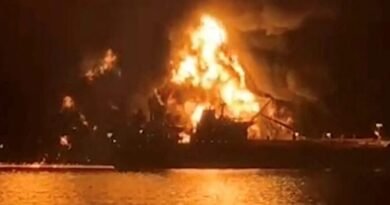
The Philippine Coast Guard said the rescue operation followed the fire that engulfed the MV June Aster while the passenger ferry, carrying more than 130 people, was sailing past the tourist hotspot of Palawan on Wednesday. The vessel was on a journey of more than 20 hours when the deadly ferry disaster occurred.
Firefighters were able to enter the vessel for the first time on Friday after battling the blaze for more than a day. Rescuers recovered 30 bodies on Friday, while another 41 charred remains were subsequently discovered, bringing the confirmed death toll to 76.

Authorities said rescue teams had finally gained access to sections of the ferry that had previously been difficult to reach because of thick smoke and extreme heat. According to the Coast Guard, burnt remains were found inside the vessel’s economy accommodation section, where conditions remained particularly challenging for rescue and recovery personnel.
Identification of Victims Becomes Immediate Priority
Philippine Coast Guard official Geronimo Tuvilla said the immediate priority was to identify the victims and establish what caused the fire. The recovery operation has now shifted toward forensic examination as authorities work to determine the identities of those who died in the passenger ferry fire.
Responders wearing protective suits were seen carrying black body bags from a Coast Guard vessel into tents erected in nearby Coron Town. The recovered bodies were transported there for identification, while anxious relatives waited for information about family members who were aboard the MV June Aster.
Among those waiting was 37-year-old Anelyn Magbanua, whose husband had been returning to Coron after visiting their children in Manila when the ferry caught fire near the end of its journey.
She expressed hope that her husband had survived and might have reached another island rather than being among those recovered from the vessel.
The identification process is expected to be particularly difficult because of the severe damage caused by the fire. Authorities are relying on forensic procedures to establish the identities of victims as families await confirmation about their loved ones.
Severe Fire Damage Inside MV June Aster
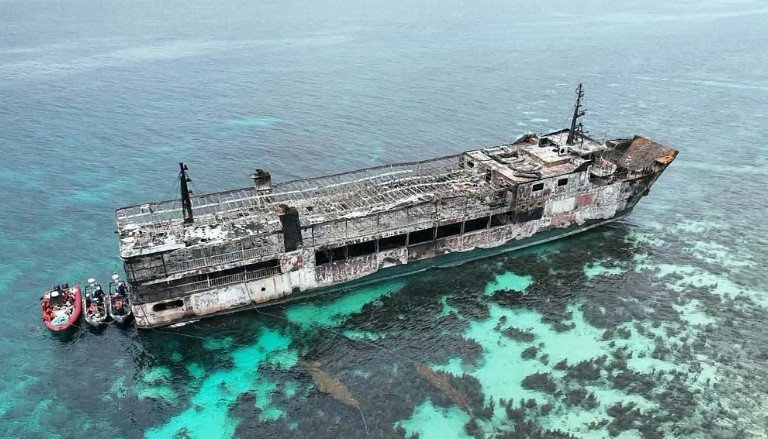
Images released by the Philippine Coast Guard showed the extensive destruction inside the vessel. Rows of steel bed frames had been twisted by the intense heat and were covered in ash, illustrating the severity of the ferry fire.
Some photographs appeared to show skeletal remains among the debris, underscoring the difficult conditions facing investigators and recovery teams working inside the damaged vessel.
The scale of the destruction has also raised questions about how quickly the fire spread through the ferry and what factors may have contributed to the high number of fatalities.
According to a statement from the Maritime Industry Authority, which cited accounts from survivors, two explosions were heard inside the vessel shortly before the fire broke out.
One survivor recalled seeing a small amount of smoke before it developed into a fire that spread rapidly through the ferry within seconds.
The account has added to questions surrounding the sequence of events and the speed at which the maritime emergency developed onboard the vessel.
Questions Surround Fate of Ferry Captain
Authorities are also seeking clarification about the fate of the MV June Aster’s captain.
Coast Guard spokesperson Commodore Noemie Cayabyab said she had received information indicating that the captain was alive. However, the captain’s name was not included on the official list of the 43 confirmed survivors.
The conflicting information has left further questions about the captain’s whereabouts and his role in the incident. Authorities are expected to establish a clearer account of the vessel’s final moments as the investigation into the maritime accident continues.
The cause of the fire has not yet been established. Investigators will need to examine survivor accounts, the physical evidence recovered from the vessel and other available information to determine how the fire began and why it spread so rapidly.
Philippines Faces Continuing Maritime Safety Challenges
The MV June Aster disaster is the latest in a series of deadly maritime accidents in the Philippines, an archipelago of more than 7,600 islands where millions of people depend on ferries and smaller boats for transportation between provinces and islands.
Passenger ferries play a critical role in the country’s transportation network, particularly because of the Philippines’ geography and the large number of communities separated by waterways.
The latest disaster has therefore placed renewed attention on maritime safety, emergency response, passenger vessel operations and the protection of people travelling by sea.
For now, rescue and recovery teams remain focused on locating the 13 people still unaccounted for, identifying the recovered victims and determining the circumstances that led to the catastrophic fire aboard the MV June Aster.
As forensic teams continue their work in Coron Town and investigators examine the heavily damaged ferry, families are waiting for definitive answers about their loved ones, while authorities face the urgent task of determining what caused one of the Philippines’ latest deadly ferry disasters.