
Op-Ed: World Tuna Day 2026:The Race Between Exploitation and Conservation in Global Fisheries
As the ocean’s most commercially valuable fish faces mounting pressure from industrial fleets, climate displacement, and inadequate governance, the annual observance arrives with renewed urgency ,and a sobering scorecard.
Introduction
A Species at the Crossroads
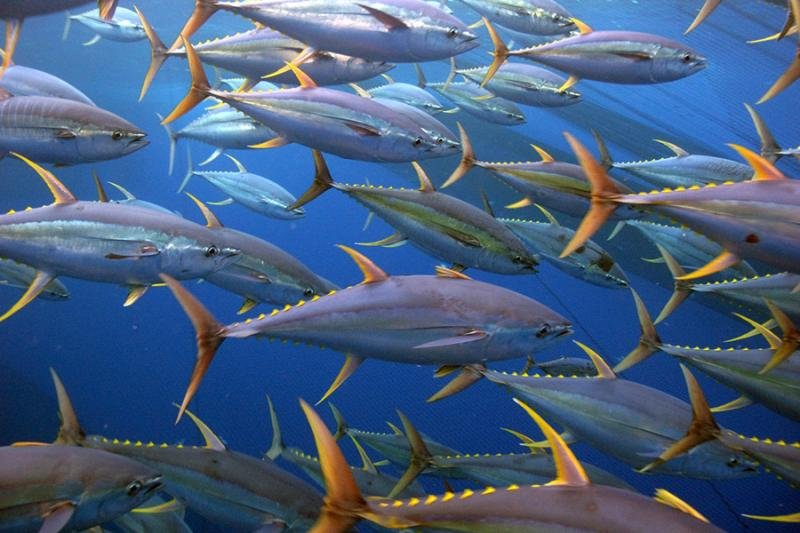
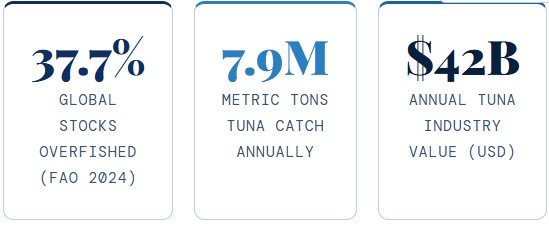
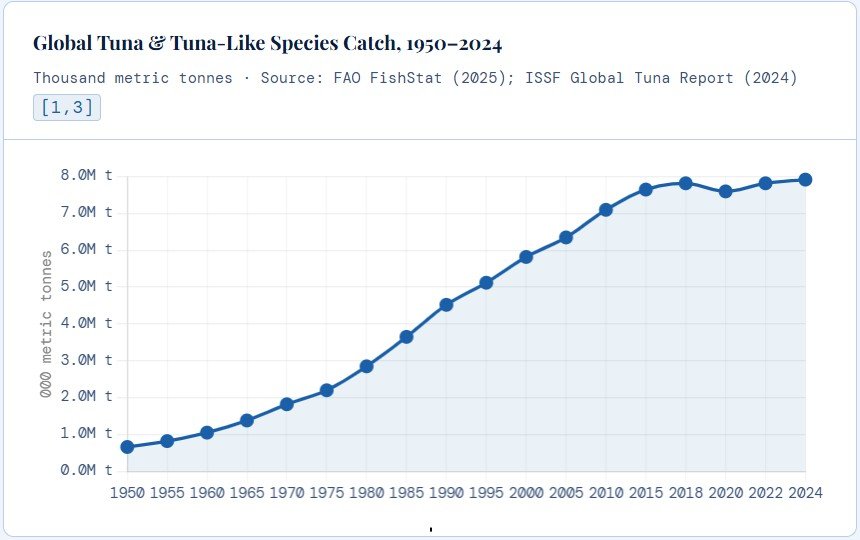
Every second of May, the world pauses , briefly , to acknowledge the tuna: a fish so perfectly engineered by evolution that it can outswim a speedboat, warm its own blood, and cross entire ocean basins in a matter of weeks. Yet in 2026, the tuna’s greatest adversary is neither faster nor more elegant. It is a global fishing industry that extracts over 7.9 million metric tons of tuna and tuna-like species annually, a figure that edges ever closer to what science tells us the oceans can sustainably bear [1].
The United Nations formally designated May 2nd as World Tuna Day in 2016, recognizing the fish’s ecological and economic importance to billions of people across the Indo-Pacific, the Atlantic, and beyond. A decade on, the occasion carries less celebratory weight and more diagnostic urgency. FAO stock assessments published in 2024 confirmed that approximately 37.7% of the world’s assessed marine fish stocks are fished beyond biologically sustainable levels — up from 10% in 1974 [2]. Among large pelagic species, tuna stocks bear a disproportionate share of that pressure.
This analysis examines where the science stands, what the geopolitics of fisheries governance are producing, and why the 2026 edition of World Tuna Day demands more than symbolic declarations.
The Science
What Stock Assessments Are Telling Us
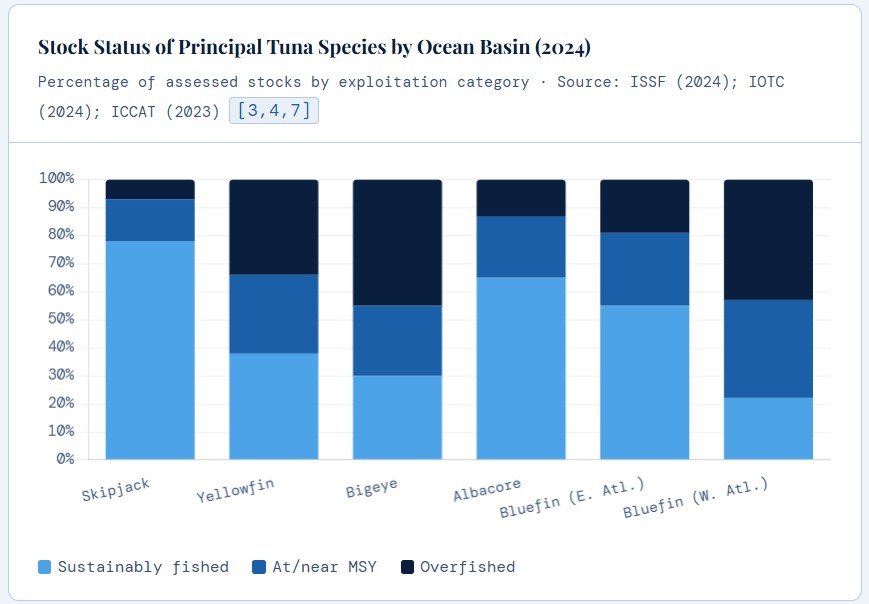
The International Seafood Sustainability Foundation (ISSF) tracks eight principal commercial tuna species across the world’s ocean basins. Its 2024 Status of the World Fisheries for Tuna report categorized 33 of 61 assessed tuna stocks as being harvested at or above maximum sustainable yield (MSY) [3].
That finding, while an improvement over the 2014 nadir, masks significant regional disparities that aggregate statistics routinely obscure.
Atlantic Bluefin: Cautious Recovery, Fragile Gains
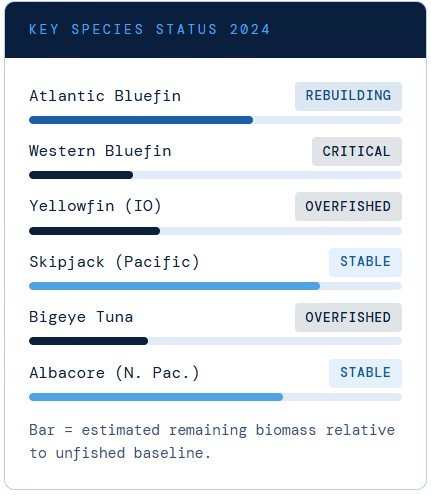
The Eastern Atlantic and Mediterranean bluefin tuna (Thunnus thynnus) population has shown genuine recovery since ICCAT implemented strict quota reductions after 2010. Stock biomass estimates in the 2023 ICCAT assessment placed the spawning stock biomass at approximately 1.8 times Blim, the strongest reading in three decades [4]. Yet experts warn that this recovery is not grounds for complacency: the stock remains below BMSY, and climate-driven shifts in prey distribution are introducing new uncertainty into model projections [5].
The Western Atlantic population tells a grimmer story. Despite decades of management attention, the 2022 ICCAT assessment estimated the western bluefin stock at roughly 53% of its historical unfished biomass, with recruitment persistently below long-term averages ,a pattern some researchers link to oceanographic changes affecting larval survival in the Gulf of Mexico spawning grounds [6].
“The tuna is not simply a fish. It is a barometer of ocean health, a test of international governance, and a measure of whether humanity can manage a shared resource across borders and generations.”— Pauly & Zeller, Sea Around Us Project, 2023
Skipjack and Yellowfin: The Pressure Shifts
As luxury species like bluefin receive management attention, industrial fishing effort has pivoted heavily to skipjack (Katsuwonus pelamis) and yellowfin (Thunnus albacares), which together constitute over 60% of global tuna landings [3].
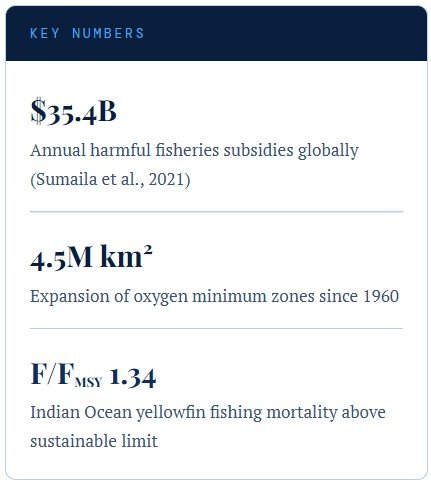
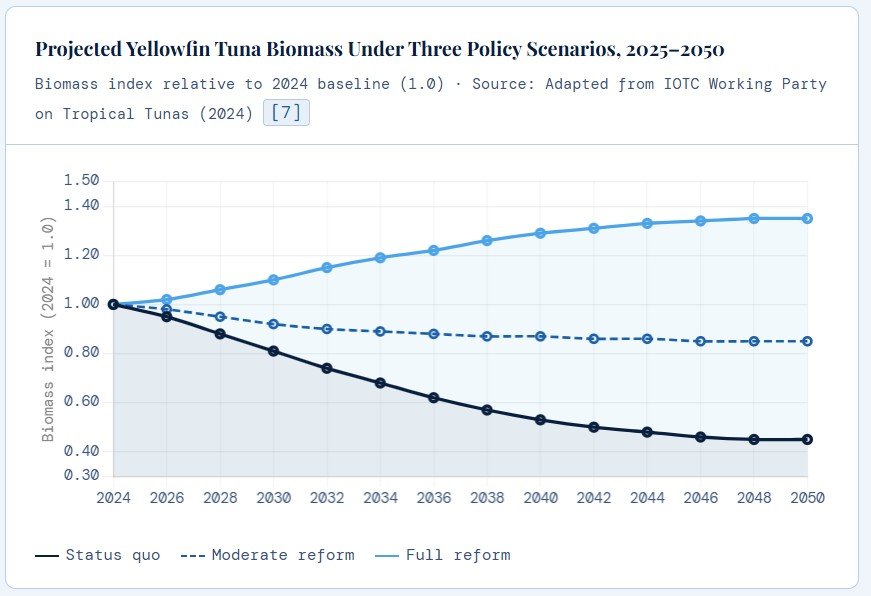
Pacific skipjack stocks remain broadly within sustainable bounds, but yellowfin in the Indian Ocean is a serious concern. The IOTC 2024 assessment placed Indian Ocean yellowfin at F/FMSY = 1.34, meaning fishing mortality is 34% above the maximum sustainable level [7].
Bigeye Tuna: The Silent Casualty of IUU Fishing
Bigeye tuna (Thunnus obesus) occupies a unique commercial niche , prized for sashimi, it commands prices that incentivize significant illegal, unreported, and unregulated (IUU) fishing. A 2023 analysis in Fish and Fisheries estimated that IUU catch of bigeye across all ocean basins may represent between 15 and 32% of reported landings [8].
If the true removals are at the high end of these estimates, bigeye populations in the Atlantic and Indian Oceans may be in far worse condition than official assessments suggest.
Critical Finding
IUU fishing for bigeye tuna is estimated at 15–32% of reported landings globally, rendering official stock assessments potentially unreliable and conservation targets structurally unachievable [8].
Climate Dimension
The Invisible Pressure: Ocean Warming and Trophic Disruption
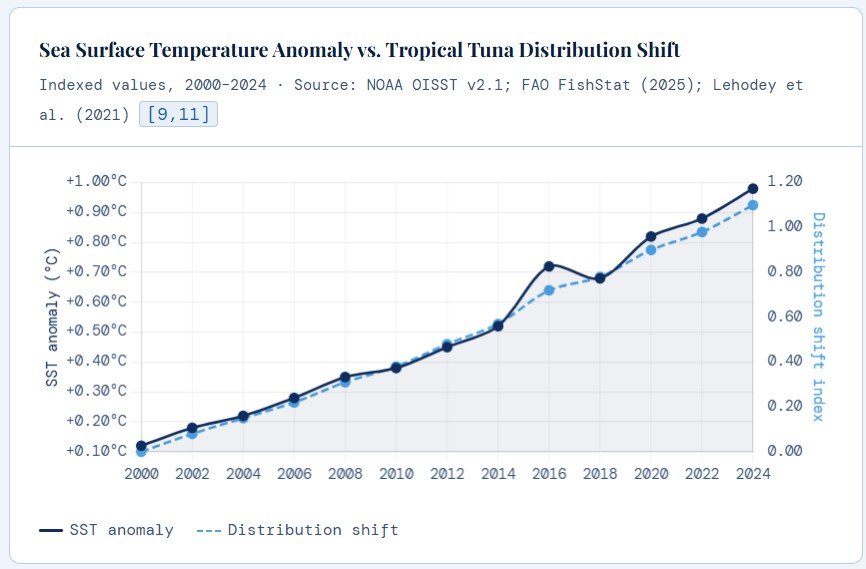
A landmark 2021 meta-analysis in Science projected that continued ocean warming under RCP 8.5 scenarios would shift skipjack tuna distributions poleward by approximately 1.5–2.5 degrees of latitude per decade, redistributing catch potential away from small island developing states in the equatorial Pacific toward higher-latitude nations , and toward ocean areas that sit outside existing RFMO regulatory frameworks [9].
The Pacific Islands Forum Fisheries Agency (FFA), whose member states derive between 30–90% of national government revenue from tuna access fees, faces the prospect of the fish they depend on physically migrating away from their Exclusive Economic Zones [10]. Meanwhile, the legal architecture for managing tuna on the high seas was designed for a world where stock distributions were broadly stable.
Ocean deoxygenation compounds this challenge. Research published in Global Change Biology demonstrated that oxygen minimum zones of the tropical Pacific and Indian Oceans have expanded by approximately 4.5 million km² since 1960 [12].
As OMZs expand, tuna concentrate in thinner surface layers, making them dramatically easier to catch by purse seiners , a perverse subsidy to industrial fishing efficiency at precisely the moment when stock buffers are thinnest.
Governance Failures
The Governance Gap: Why RFMOs Are Falling Short
The world’s five tuna RFMOs collectively manage the most commercially valuable fisheries on earth, yet a systematic evaluation published in PLOS ONE (2023) found that none achieved a “good” rating on all metrics, with chronic failures in compliance monitoring, precautionary approach implementation, and ecosystem-based management [13]. RFMOs operate by consensus, meaning any single powerful fishing nation can block science-based quota reductions.
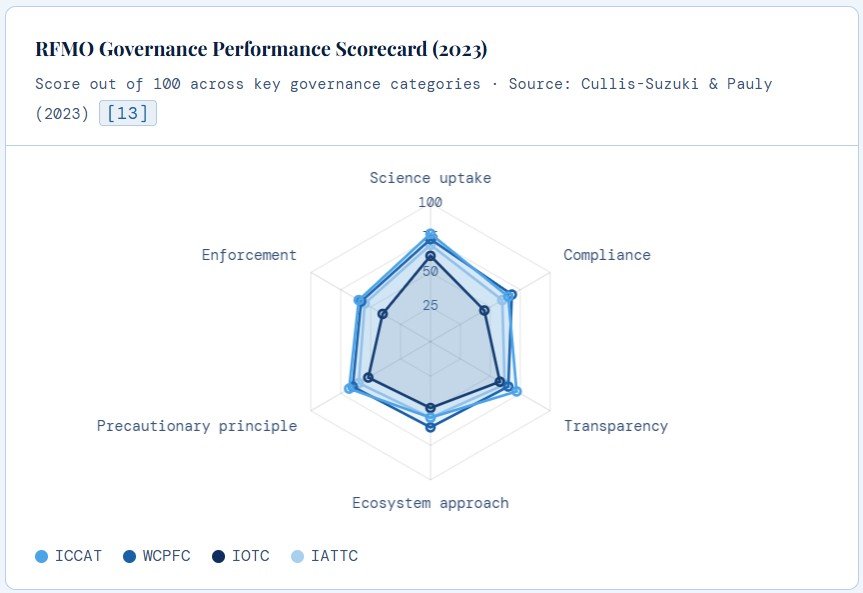
The 2023 High Seas Treaty (BBNJ Agreement) offers a potential structural fix, establishing marine protected areas and environmental impact assessments for the high seas. As of May 2026, however, the treaty has been ratified by only 41 of the 60 nations required for entry into force, with key distant-water fishing nations not yet among the ratifiers [14].
“We keep writing better science and enacting weaker policy. The knowledge-action gap in tuna management is not a technical failure ,it is a political one.”— Sumaila et al., Nature Sustainability, 2022
Pathways Forward
What Would Meaningful Progress Actually Look Like?
The conservation literature is not short on prescriptions. What it lacks is a political mechanism for implementation. Three evidence-based interventions stand out as both technically feasible and potentially transformative.
1. Closing the IUU Data Gap with Digital Monitoring
Partnerships between SkyTruth, Global Fishing Watch, and the Minderoo Foundation have demonstrated that cross-referencing AIS dark events with radar satellite imagery can identify probable IUU fishing with over 87% accuracy [15]. The barrier is not technological ,it is political will to compel flag states to mandate full electronic monitoring and share data with RFMOs.
2. Reforming Harmful Subsidies
A 2021 study in Marine Policy estimated that global fisheries subsidies totaling approximately USD 35.4 billion annually actively support the expansion of fishing capacity beyond sustainable limits [16]. The 2022 WTO Agreement on Fisheries Subsidies prohibits subsidies for fishing on overfished stocks and IUU fishing, but its enforcement mechanisms remain weak and its coverage of capacity-enhancing subsidies incomplete.
3. Expanding High-Seas Marine Protected Areas
Modeling work published in Science Advances (2022) demonstrated that protecting 30% of the high seas in strategically selected areas could increase tuna biomass across all ocean basins by an estimated 18–23% within 20 years [17]. The “30×30” biodiversity target provides political scaffolding for this approach, but no mechanism yet exists to translate the target into specific high-seas MPA designations that bind fishing fleets.
Editorial Verdict
The Verdict on World Tuna Day 2026
World Tuna Day is not, and should not be, merely an occasion for aquatic appreciation. It is, or ought to be, an accountability moment: a structured opportunity to ask whether the institutions tasked with managing one of the ocean’s most consequential shared resources are doing so responsibly. In 2026, the honest answer is: incompletely, inconsistently, and with inadequate urgency.
The science is robust and the direction is clear. The political economy is stubborn. Industrial fishing interests are concentrated, well-funded, and geopolitically entrenched in the very multilateral processes that are supposed to constrain them.
The Atlantic bluefin recovery, however partial and fragile, demonstrates that well-designed, enforced quota systems can allow commercially depleted species to rebuild. The question is whether the political architecture exists, or can be created, to replicate that outcome for yellowfin, bigeye, and the broader suite of large pelagic species before exploitation outruns the science.
Read: The Rising Tide of Technology: Remote Sensing is transforming the Future of Fisheries
For the tuna, time is not neutral. Every year of delay in adopting precautionary measures is a year of deficit spending against a biological account that does not offer overdraft protection. On World Tuna Day 2026, exploitation still leads. The margin, however, is narrowing, in both directions.
Scientific References
- [1] FAO. (2024). The State of World Fisheries and Aquaculture 2024. Food and Agriculture Organization of the United Nations, Rome. DOI: 10.4060/cd0683en
- [2] FAO. (2024). FishStat Global Capture Production Database. Accessed April 2026.
- [3] ISSF. (2024). Status of the World Fisheries for Tuna: 2024 Edition. ISSF Technical Report 2024-02.
- [4] ICCAT. (2023). Report of the 2022 ICCAT Atlantic Bluefin Tuna Stock Assessment. SCRS/2022/165.
- [5] Muhling, B.A. et al. (2023). Climate-driven shifts in Atlantic bluefin tuna recruitment. Fisheries Oceanography, 32(4), 312–328.
- [6] Rooker, J.R. et al. (2022). Declining western Atlantic bluefin tuna. ICES Journal of Marine Science, 79(2), 588–601.
- [7] IOTC Working Party on Tropical Tunas. (2024). Report of the 26th Session. IOTC-2024-WPTT26-R.
- [8] Navarro, J. et al. (2023). Estimating IUU fishing mortality for bigeye tuna. Fish and Fisheries, 24(3), 445–463.
- [9] Lehodey, P. et al. (2021). Climate change–driven redistribution of tropical tuna species in the Pacific Ocean. Science, 372(6545), 895–900.
- [10] FFA. (2024). Tuna Fisheries: Economic and Policy Outlook 2024. Pacific Islands Forum Fisheries Agency.
- [11] NOAA NCEI. (2025). Optimum Interpolation Sea Surface Temperature v2.1 (OISST).
- [12] Stramma, L. et al. (2022). Expanding oxygen minimum zones and tuna habitat compression. Global Change Biology, 28(9), 3012–3027.
- [13] Cullis-Suzuki, S. & Pauly, D. (2023). Reforming the five tuna RFMOs. PLOS ONE, 18(5), e0285741.
- [14] UNDOALOS. (2026, April). Status of the BBNJ Agreement. United Nations Division for Ocean Affairs and the Law of the Sea.
- [15] Global Fishing Watch. (2023). Satellite-Based Monitoring of Dark Fishing Events. Global Fishing Watch Research Series.
- [16] Sumaila, U.R. et al. (2021). Financing a sustainable ocean economy. Nature Communications, 12, 3259.
- [17] Sala, E. et al. (2022). Protecting the global ocean for biodiversity, food and climate. Science Advances, 8(3), eabf6897.