First Multipurpose Cargo Vessel Uses Wind-Assisted Propulsion
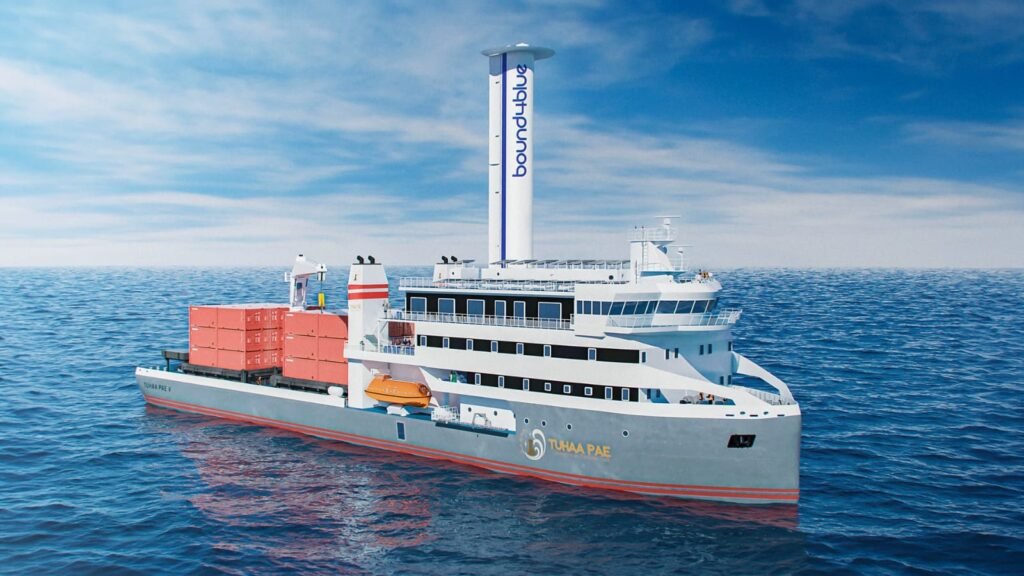
The global shipping industry is accelerating the adoption of wind-assisted propulsion technology as shipowners seek to reduce fuel consumption, operating costs, and greenhouse gas emissions. In a significant development for green shipping and maritime decarbonization, the multipurpose cargo vessel Na Hiro E Pae has been fitted with a 22-meter-high eSAIL suction sail developed by Spanish wind propulsion company bound4blue, marking a major step in bringing wind-assisted propulsion to the multipurpose cargo vessel segment.
The 89-meter vessel is owned by Greek shipping company Société de Navigation des Australes SNA Tuha’a Pae and will provide an essential maritime transport link between Tahiti and the remote Austral Islands in French Polynesia. The vessel is designed to transport passengers, food supplies, and general cargo, with capacity for up to 200 passengers and 1,500 tonnes of supplies. Its engines are also designed to operate on biofuel or e-fuel when such fuels become commercially available in the region. bound4blue originally announced the selection of its eSAIL for the newbuild in January 2024, describing the project as the first selection of its technology for a newbuild vessel of this type.
Wind-Assisted Propulsion Technology Targets Lower Energy Consumption
The wind-assisted propulsion system installed on Na Hiro E Pae uses a 22-meter vertical suction sail to harness wind energy and provide additional thrust. Unlike conventional sails, the eSAIL uses an aerodynamic profile combined with suction technology that draws air across the sail, increasing its propulsive performance.
According to bound4blue, the technology can generate approximately seven times the propulsive force of a conventional rigid sail of the same size. By providing part of the vessel’s propulsion through wind energy, the system reduces the workload placed on the main engines, potentially lowering fuel consumption and associated emissions. For Na Hiro E Pae, the system is expected to reduce energy consumption by approximately 10 percent.
The technology is particularly significant because multipurpose vessels have traditionally presented greater challenges for wind propulsion. Their operations require flexibility in cargo handling, vessel configuration, loading conditions, and route management. Integrating a large wind propulsion system therefore requires close coordination among the shipowner, naval architects, shipyard, and technology provider.
bound4blue CEO José Miguel Bermúdez has described the project as evidence that collaboration among different maritime stakeholders can overcome the integration challenges associated with applying wind power to multipurpose vessels.
Maritime Transport for Remote Austral Islands
Na Hiro E Pae is being developed not only as a more energy-efficient vessel but also as an important component of maritime connectivity in French Polynesia. The vessel will operate alongside Tuhaa Pae IV, which entered service on the route in 2012 and has transported essential products including gasoline, gas, and passengers.
The Austral Islands consist of five inhabited islands with a combined population of approximately 7,000 people. Reliable maritime transportation is therefore critical for the movement of essential supplies and passengers between the islands and Tahiti.
The vessel’s combination of passenger and cargo capacity demonstrates an important application of sustainable maritime transport technology: rather than treating decarbonization solely as an issue for large commercial ships on international routes, wind-assisted propulsion can also be applied to vessels performing essential regional transport services.
Green Shipping Technology Combined With Alternative Fuels
Na Hiro E Pae’s propulsion strategy extends beyond wind energy. The vessel is also designed with engines capable of using biofuel or e-fuel once those fuels become commercially available in the region.
This combination is strategically important for maritime decarbonization. Wind-assisted propulsion can reduce the amount of energy required from the main engines, while alternative fuels can potentially reduce the carbon intensity of the remaining energy demand. The approach therefore represents a multi-technology pathway toward lower-emission shipping, rather than relying on a single propulsion solution.
The original project description also highlighted other efficiency features, including electric pod propulsion, fresh-water autonomy, and improved waste treatment.
Why the Na Hiro E Pae Project Matters for Shipping
The importance of Na Hiro E Pae extends beyond the vessel itself. The project demonstrates that wind propulsion for commercial ships is moving into increasingly diverse vessel categories.
bound4blue has already deployed its eSAIL technology on other vessel types, including fishing vessels and general cargo vessels, while its development pipeline has included tankers, ro-ro vessels, bulk carriers, and other commercial ships. The company states that its technology was initially developed to provide scalable renewable propulsion capable of reducing fuel consumption and emissions in commercial shipping.
For shipowners, the economic argument is particularly important. Fuel remains one of the largest operating expenses for many commercial vessels. A propulsion technology that can reduce engine load through renewable wind energy could potentially improve fuel efficiency, energy efficiency, and emissions performance while allowing vessels to continue using conventional or alternative fuels when wind conditions are insufficient.
Wind Propulsion Moves From Concept to Commercial Strategy
The Na Hiro E Pae project illustrates a broader transformation taking place in the maritime sector. Wind-assisted propulsion is no longer limited to historical sailing concepts or experimental vessels; it is increasingly being engineered as a supplementary propulsion technology for modern commercial ships.
The most important development is not simply the installation of a large sail. It is the integration of renewable wind energy into a vessel’s overall energy-management strategy. Modern commercial shipping is moving toward a model in which several technologies, wind propulsion, alternative fuels, energy-efficient hull designs, electric systems, and digital optimization, can work together to reduce fuel consumption.
For multipurpose vessels serving remote communities, this approach may have particular significance. These ships often operate on routes where fuel logistics can be expensive and infrastructure for alternative fuels may be limited. Reducing propulsion energy requirements through locally available wind resources could therefore provide both environmental and operational advantages.
At the same time, wind-assisted propulsion should be viewed as a supplementary propulsion technology rather than a complete replacement for marine engines. Vessel performance will depend on wind availability, route characteristics, cargo loading, operational requirements, and the effectiveness of integrating the system with conventional propulsion.
The Na Hiro E Pae project therefore represents an important real-world test of whether wind energy can become a commercially useful component of the energy mix for multipurpose cargo and passenger vessels.
Growing Wind Propulsion Market
The project is also significant for bound4blue’s rapidly expanding commercial portfolio. The company has reported deployments and orders involving multiple vessel categories, demonstrating growing interest in wind-assisted ship propulsion as the shipping industry searches for practical solutions to reduce fuel consumption and emissions. Its installation catalogue lists Na Hiro E Pae as a mixed-cargo vessel equipped with a 22-meter eSAIL.
As maritime regulations and environmental requirements continue to encourage lower-carbon operations, technologies capable of reducing fuel demand without requiring an immediate transition to entirely new fuels could become increasingly attractive to shipowners.
For the remote communities of French Polynesia, the immediate objective is reliable maritime connectivity. For the wider shipping industry, however, Na Hiro E Pae offers a much broader lesson: the future of green shipping may depend not on one revolutionary fuel, but on combining multiple technologies that make every tonne of cargo and every passenger transported more energy-efficient.