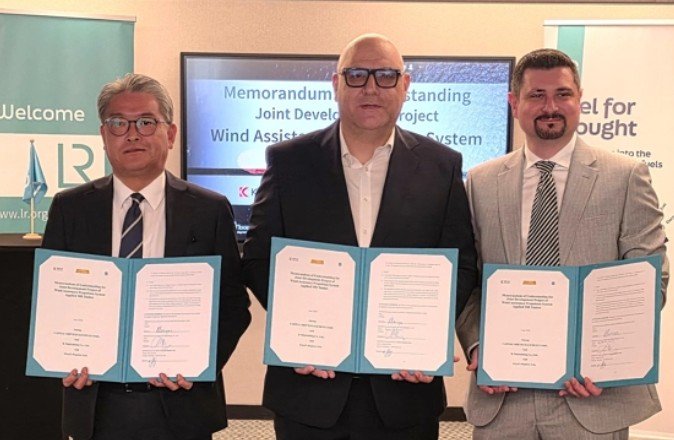
Capital Ship Management, K Shipbuilding and Lloyd’s Register Launch Wind-Assisted MR Tanker Project to Advance Green Shipping
In a significant step toward maritime decarbonization and fuel-efficient shipping, Capital Ship Management Corp., K Shipbuilding, and Lloyd’s Register (LR) have launched a Joint Development Project (JDP) to design a 50,000 dwt wind-assisted Medium Range (MR) tanker. The initiative aims to determine whether Wind-Assisted Propulsion Systems (WAPS) can deliver commercially viable fuel savings and emissions reductions for standard product tanker operations without compromising cargo capacity or operational flexibility.
While wind-assisted propulsion has already gained momentum across bulk carriers and several specialist vessel segments, its adoption in the MR tanker market has remained limited. The new collaboration seeks to close that gap by evaluating how modern wind propulsion technologies can be integrated into a competitive tanker design that meets both commercial and environmental requirements.
The project brings together the operational experience of Capital Ship Management, the tanker design and construction expertise of K Shipbuilding, and Lloyd’s Register’s regulatory and technical assurance capabilities. Together, the partners will tackle the engineering, compliance, and design challenges associated with integrating wind-assisted propulsion into mainstream tanker operations.
As part of the initiative, the partners will carry out detailed technical studies, optimize vessel design, and conduct regulatory assessments that will support future Approval in Principle (AiP) activities. These efforts are intended to establish a practical pathway for the commercial deployment of wind-assisted MR tankers, supporting the shipping industry’s transition toward low-carbon maritime transport.
The signing of the Joint Development Project marks the beginning of a broader technical program focused on evaluating the operational, engineering, and regulatory aspects of wind-assisted tanker designs. The ultimate objective is to create commercially competitive vessels capable of improving fuel efficiency while helping shipowners meet increasingly stringent environmental regulations.
Theo Kourmpelis, Global Business Director for Tankers at Lloyd’s Register, said wind-assisted propulsion has already demonstrated its ability to improve vessel efficiency, but wider market adoption will depend on proving that it offers measurable commercial benefits for mainstream shipping sectors such as MR tankers. He added that shipowners are increasingly looking for technologies that improve operational efficiency while supporting compliance with evolving international environmental regulations, and this project will help assess how wind propulsion can be effectively incorporated into future tanker designs.
Nikolas Vaporis, Chief Technical Officer of Capital Ship Management Corp., noted that the company’s six MR tankers delivered in 2023 were all built with Wind-Assisted Ready notation, reflecting its long-term belief in the commercial potential of wind propulsion for this vessel segment. He said the new project represents the next stage in that strategy, moving from vessels that are “ready” for wind propulsion to designs that can demonstrate real fuel efficiency and emissions reductions while maintaining the operational flexibility required by charterers.
Tae-Hyun Koh, Chief Technology Officer at K Shipbuilding, said the partnership supports the shipbuilder’s commitment to developing next-generation eco-friendly vessels as the maritime industry accelerates its transition toward sustainable growth. He added that the collaboration will strengthen K Shipbuilding’s capabilities in advanced green ship design while reinforcing its competitive position in the global MR tanker market.
The project reflects the shipping industry’s growing focus on innovative technologies that combine commercial performance with environmental sustainability. As pressure increases to reduce greenhouse gas emissions, wind-assisted propulsion is emerging as a promising solution to help shipowners improve fuel efficiency, lower operating costs, and comply with global decarbonization targets, making it an increasingly important technology for the future of the tanker sector.