IMO Council Reaffirms Freedom of Navigation, Condemns Strait of Hormuz Attacks and Strengthens Global Maritime Safety Measures
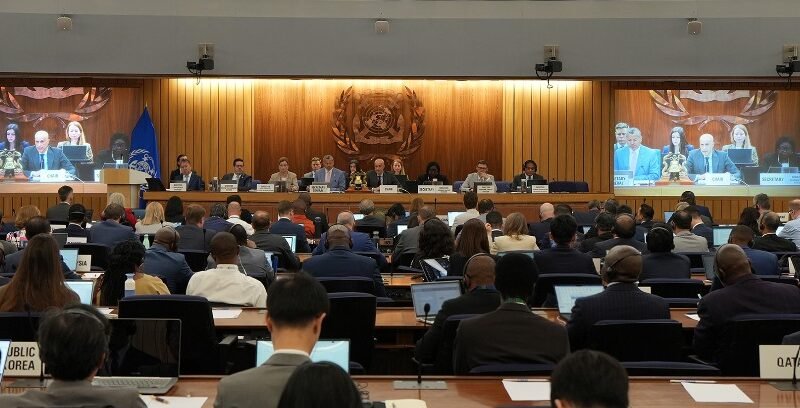
The International Maritime Organization (IMO) Council has reaffirmed its commitment to protecting freedom of navigation, international maritime law, and the safety of seafarers, while condemning attacks on civilian commercial vessels operating in and around the Strait of Hormuz. The decisions were announced at the conclusion of the IMO Council’s 137th session, highlighting the organization’s continued focus on secure global shipping, uninterrupted maritime trade, and international cooperation.
In a resolution adopted during the session, the IMO Council emphasized that the right of transit passage through international straits must not be threatened, obstructed, denied, impaired, or suspended. The Council stressed that all ships must continue to enjoy safe and non-discriminatory passage through internationally recognized shipping routes in accordance with international law and IMO regulations.
Addressing growing security concerns in the Strait of Hormuz, one of the world’s busiest maritime trade corridors, the Council strongly condemned attacks targeting civilian commercial ships and called for an immediate de-escalation of regional tensions in the Middle East. It reaffirmed that all arrangements between the coastal states surrounding the Strait must guarantee unrestricted and non-discriminatory transit for every vessel using the IMO-adopted Traffic Separation Scheme established in 1968.
The Council also reiterated that passage through the Strait of Hormuz should remain free from tolls or additional charges in accordance with international law and relevant IMO conventions. To further strengthen maritime security and navigational safety, the Council requested the IMO Secretary-General to explore practical solutions with littoral states, member governments, and the global shipping industry to ensure the safe and sustainable restoration of unhindered navigation through the strategic waterway.
The session also highlighted the successful Cooperative Mechanism for the Straits of Malacca and Singapore, where Indonesia, Malaysia, and Singapore continue to jointly manage one of the world’s busiest shipping lanes through close collaboration between governments and the maritime industry. The IMO Council encouraged member states and stakeholders to provide financial or in-kind support to the Aids to Navigation Fund and the IMO Straits of Malacca and Singapore Trust Fund, helping strengthen navigational safety and environmental protection in the region.
Beyond navigation and maritime security, the Council approved the IMO’s 2025 Annual Report and reviewed the organization’s strong financial performance. Member State contributions continued to be the primary source of funding, achieving an impressive assessment collection rate of 99.10%, one of the highest across the United Nations system. Total revenue increased by 2.97% to £77.96 million, supported by assessed contributions as well as higher publication and cafeteria sales.
The Council also approved an updated Risk Management Policy together with a new Strategic Fraud Risk Management Annex, reinforcing IMO’s commitment to transparency, accountability, and its zero-tolerance policy toward fraud and corruption.
Progress under the IMO Member State Audit Scheme (IMSAS) was another key achievement discussed during the session. Since mandatory audits began in 2016, the organization has completed 168 audits covering 165 Member States and three Associate Members. Of the five audits scheduled for 2026, Belarus, Haiti, and Mozambique have already been completed, while Eritrea and Yemen remain on schedule. The Council encouraged audited countries to make their audit reports publicly available to further improve transparency across the global maritime sector.
The Council also granted consultative status to several maritime organizations, including the International Electric Marine Association (IEMA), the Mærsk Mc-Kinney Møller Center for Zero Carbon Shipping (MMMCZCS), and SEA-LNG. The Ocean Foundation (TOF) received provisional consultative status for up to two years, after which its status will be reviewed.
Looking ahead, the Council welcomed Qatar’s offer to host the World Maritime Day Parallel Event in 2028. The 2026 event will take place in Busan, Republic of Korea, followed by the Philippines in 2027. Meanwhile, this year’s World Maritime Day will be celebrated at IMO Headquarters on 24 September under the theme “From Policy to Practice: Powering Maritime Excellence.”
The Council also confirmed that the 2026 IMO Awards Ceremony will be held at IMO Headquarters in London on 14 December 2026. The 2026 IMO Award for Exceptional Bravery at Sea will be presented posthumously to Mr. Adrian Willyson Brask, nominated by Norway and the International Federation of Shipmasters’ Associations (IFSMA). Two additional recipients will receive Certificates of Commendation, while eleven others will be recognized with Letters of Commendation for acts of exceptional bravery.
In recognition of outstanding contributions to international shipping, the Council selected Mr. Jeffrey G. Lantz, nominated by the United States, as the recipient of the 2025 International Maritime Prize. Rear Admiral Peter Brady will receive a Letter of Commendation for his significant contributions to maritime development in Jamaica, the Caribbean, and the broader objectives of the International Maritime Organization.
Source: International Maritime Organization (IMO)