Untreated Wastewater Discharge: A Microbiological Threat to Coastal Sustainability
By Tooba Haider
Every day, the world sends hundreds of millions of cubic meters of human waste toward its coastlines, through outfalls, storm drains, and the overflow valves of aging sewers, and roughly half of it arrives essentially untreated. This is not a hypothetical environmental externality. It is a microbiological exposure event, repeated daily, at the exact places where people swim, fish, and harvest shellfish. The public conversation about wastewater tends to default to aesthetics: odor, discoloration, the occasional beach closure sign. The more consequential story is written in colony-forming units, resistance genes, and epidemiological odds ratios, and it argues for treating coastal sewage discharge as a first-order public-health and biosecurity issue, not a downstream nuisance.
Discharges from local and industrial sewage are a major cause of environmental pollution in coastal ecosystems, a concern that has been exacerbated by continuous urban expansion and economic growth (Lo et al., 2025). The growing volume and complexity of wastewater effluents mean a wide range of chemical, nutritional, and microbial contaminants are released into marine environments, endangering the resilience and well-being of these ecosystems.
About half of the world’s population lives close to the shore, making coastal habitats vital. However, human activities such as increased urbanization, aggressive construction, and, in particular, coastal sewage contamination pose serious risks to these environments. Untreated sewage releases a variety of nutrients, pathogenic organisms, toxic substances, plastic waste, and organic matter, seriously threatening coastal ecosystems (Rangel-Buitrago et al., 2024).
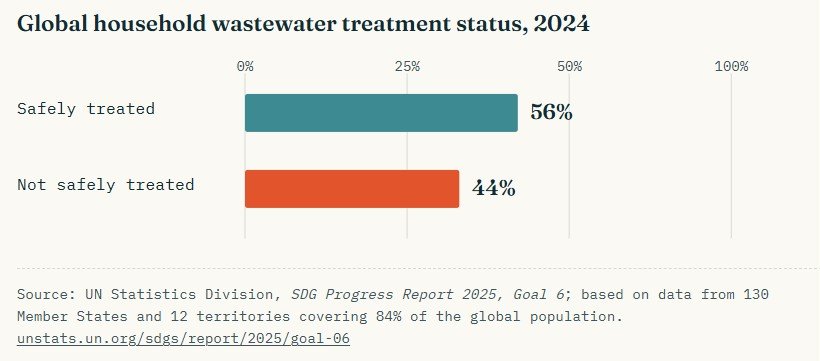
According to the United Nations’ 2025 assessment of Sustainable Development Goal indicator 6.3.1, only 56 percent of the world’s domestic wastewater, some 332 billion cubic meters, was safely treated in 2024, a figure “largely unchanged” from 2020 (UN Statistics Division, 2025)(Figure 1).
Achieving sustainable wastewater treatment and reuse requires a coordinated and integrated approach involving water management authorities, environmental agencies, and other relevant sectors, supported by effective policies and legislative frameworks. The implementation of Integrated Water Resources Management (IWRM), measured under SDG Indicator 6.5.1, is essential for maximizing the benefits of wastewater treatment and reuse while advancing the achievement of Sustainable Development Goal (SDG) 6 and other water-related objectives (UNEP, 2024). However, progress remains constrained, as more than 45% of countries continue to report inadequate pollution control measures, limiting their capacity to effectively manage wastewater and safeguard water resources (UNEP, 2024, Figure 2).
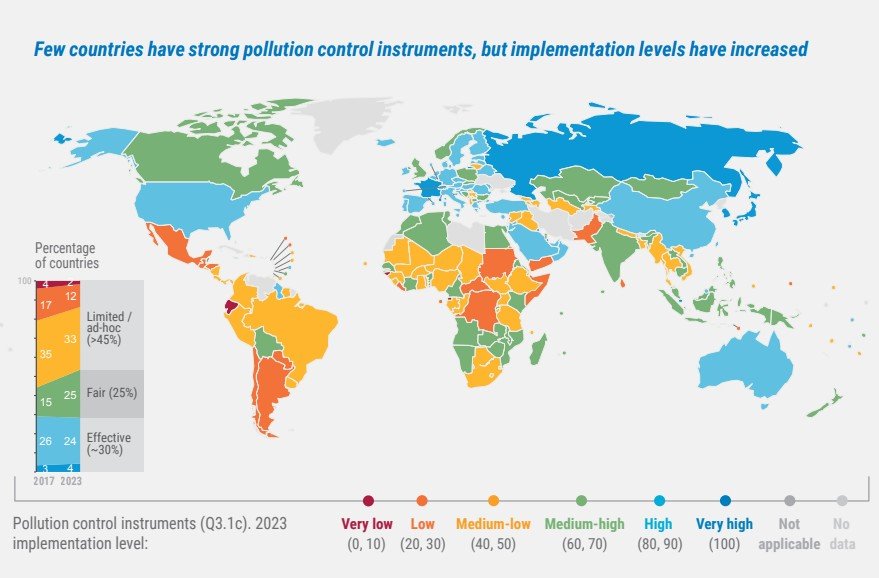
(SDG 6.5.1, UNEP, 2024)
1.The Invisible Microbial Threat
Most of the microorganisms found in wastewater are harmless and can even play a valuable role in the biological remediation of persistent harmful chemicals and the elimination of waterborne pathogens. However, wastewater also contains a large number and variety of bacteria capable of causing serious infections in people, animals, and plants (Cyprowski et al., 2018).
The World Health Organization estimates that waterborne illnesses such as cholera, typhoid, and hepatitis kill over two million people every year, largely in remote parts of developing nations, with children under five accounting for a disproportionate share of these deaths. Improving the hygienic quality of wastewater therefore requires appropriate biological (secondary treatment) and physicochemical solutions (Hassen et al., 2022).
Pathogens entering the coastal environment from land can cause serious health problems for both people and marine life, since these areas are often used for recreation and aquaculture. Marine biota can become microbially contaminated whenever human or animal waste enters the coastal environment. Microorganisms, including parasites and viruses, can accumulate near shorelines, bays, and beach sands, causing illness or mortality in humans and animals (Shapiro et al., 2018). Human and animal faeces are a key source of these pathogenic microorganisms, which are transported from upstream areas to estuarine and marine waters, particularly during floods and heavy rainfall (Malham et al., 2014). Human and animal pathogens, including bacteria, viruses, and parasites, can contaminate bathing waters primarily through fine particulate matter, and can become concentrated in filter-feeding shellfish. A wide variety of infectious microorganisms are responsible for waterborne and shellfish-borne illnesses.
In aquaculture, the widespread use of antibiotics has been reported, and this can lead to contamination of the ocean with antibiotic residues (Okeke et al., 2022). Fishing and other recreational and commercial uses of the marine and coastal environment have grown several-fold, and antibiotic-resistant bacteria have been reported in coastal waters and marine organisms since 2006 (Ben Kahla-Nakbi et al., 2006; Ben Kahla-Nakbi et al., 2009; Harakeh et al., 2006; Akinbowale et al., 2007). Vibrio alginolyticus strains, for example, were isolated from the internal organs of infected gilthead sea bream (Sparus aurata) and sea bass (Dicentrarchus labrax) (Ben Kahla-Nakbi et al., 2006).
Foodborne viruses shed by infected individuals are also widespread in discharged marine water. Both treated and untreated wastewater carry these viruses into the environment, making them a major cause of gastrointestinal and respiratory infections, conjunctivitis, and hepatitis, and contributing to illness and death among immunosuppressed people. Hepatitis A virus (HAV) is regarded as one of the most significant foodborne viruses, and can be spread through raw or undercooked shellfish.
2.Why Beach Water Quality Matters
Sewage is not a single pollutant; it is a delivery vehicle for an entire microbial community. Regulators track this indirectly, using indicator organisms rather than testing for every pathogen directly, because it is impractical to culture the full diversity of viruses, bacteria, and protozoa that human waste can carry . Escherichia coli makes up roughly 97% of the coliform bacteria found in human feces, which is why its presence functions as a proxy for fecal contamination; Enterococcus species are used similarly in marine water because they persist longer in salt water than fecal coliforms do (EPA, 2021).
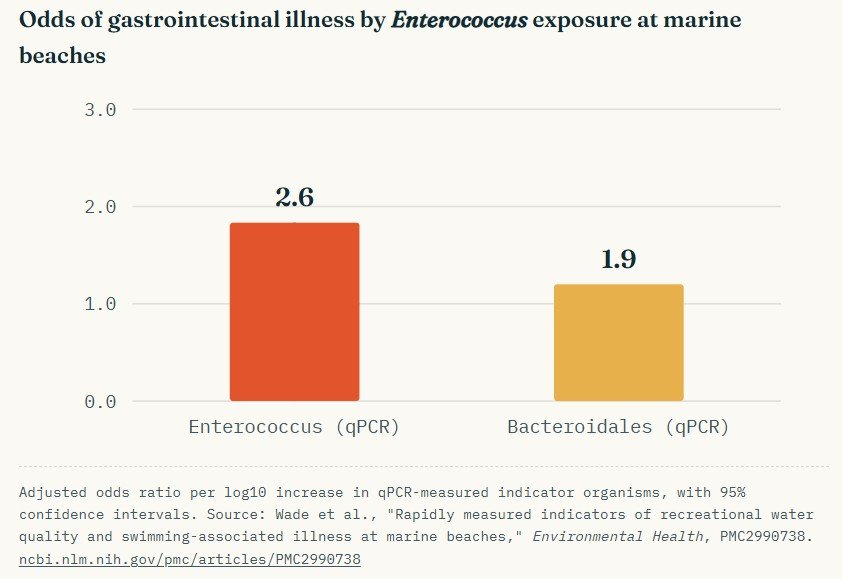
The epidemiology behind these indicators is well established. A prospective cohort study of swimmers at marine beaches affected by treated sewage discharges in Mississippi, Rhode Island, and Alabama found that a ten-fold increase in Enterococcus concentration, measured by qPCR, was associated with more than double the odds of gastrointestinal illness among swimmers (adjusted odds ratio 2.6, 95% CI 1.3–5.1)(Wade et al., 2010). A separate pooled analysis of more than 80,000 beachgoers at 13 U.S. sites found that children, in particular, faced elevated risk from fecally contaminated recreational water (Wade et al., 2022). Globally, researchers estimate that swimming in polluted water is responsible for approximately 170 million enteric and respiratory illnesses per year (Napier et al., 2017).
3.Microbial Impacts on Marine Biodiversity, Seafood Safety, and Human Health
Marine finfish and crustaceans are an important source of essential minerals, vitamins, and protein for people worldwide. Global demand for marine food fish is increasing even as fishing grounds shrink and food-safety hazards associated with pre- and post-harvest contamination grow, posing substantial challenges to seafood safety and sustainability. Marine fish stocks are under stress from the dispersion of contaminants: rising sea temperatures, the movement of microbes via marine vessels, anthropogenic activity introducing pathogenic microorganisms into seawater via rivers or direct discharge, and the introduction of harmful chemicals and antibiotic residues. Pyrogenic chemicals may also be introduced during food processing. Potentially hazardous material can accumulate in food fish beyond levels acceptable for human consumption (Samarajeewa, 2023).
4.Strategies for Sustainable Coastal Wastewater Management
Many of the world’s most important cities are port cities. Managing water supply and sewage sustainably requires the coordinated planning of pipeline infrastructure, biological wastewater treatment systems, and sludge management practices. Discharging effluent into the sea or freshwater reservoirs risks irreversible ecological damage, both inland and, ultimately, in maritime environments , a unique technological barrier to sustainability.
Sustainable water and waste management is therefore essential to the development of coastal cities, particularly amid accelerating urbanization and climate change. Innovative resource-management approaches that balance environmental stability, economic resilience, and social well-being , leveraging cutting-edge technology, adaptive urban planning, and participatory governance , are essential to addressing these challenges.
Comprehensive approaches such as zero-waste policies, improved reuse schemes, and extended producer responsibility (EPR) arrangements are imperative for reducing environmental impact and maximizing resource recovery. Beyond technological progress, municipal participation and supportive policy measures , such as pay-as-you-throw initiatives and public-private partnerships , are pivotal to encouraging behavioural change and delivering long-term, sustainable wastewater management solutions (Banerjee et al., 2022).
5.Treatment is a Policy Choice, not a Technical Ceiling
None of this reflects a lack of available technology. It reflects underinvestment, aging infrastructure, and , in many coastal jurisdictions , a regulatory default that still treats the ocean as a dilution zone rather than a shared resource with a biological carrying capacity. There are workable precedents. Florida has moved to ban ocean outfalls that discharge treated wastewater directly into the coastal zone of the southeastern part of the state, pushing utilities toward water reuse instead of disposal (TNC, 2024). Globally, SDG target 6.3 commits signatory nations to halving the proportion of untreated wastewater by 2030 , a target the UN’s own tracking shows the world is not on pace to meet (UN-Water, 2024).
The policy argument, then, is not exotic: fund the unglamorous infrastructure ,separated storm and sanitary sewers, upgraded treatment capacity, real-time monitoring at outfalls and beaches , before the next storm turns a treatment plant into a bypass valve. Coastal sustainability is usually discussed in the vocabulary of carbon, plastics, and warming water. It should also be discussed in the vocabulary of microbiology, because the organisms moving through untreated discharge are not waiting for 2030.
References
- “Exposure to human-associated fecal indicators and self-reported illness among swimmers at recreational beaches,” PMC5625766. ncbi.nlm.nih.gov/pmc/articles/PMC5625766
- “Health risks to children from exposure to fecally-contaminated recreational water,” PMC9004770. ncbi.nlm.nih.gov/pmc/articles/PMC9004770
- Akinbowale, O.L., Peng, H. and Barton, M.D. (2007) ‘Diversity of tetracycline resistance genes in bacteria from aquaculture sources in Australia’, Journal of Applied Microbiology, 103(5), pp. 2016–2025. doi:10.1111/j.1365-2672.2007.03445.x.
- Banerjee, A., Sarkar, Antariksha and Ghosal, S. (2022) ‘Challenges and strategies of water supply and wastewater management in coastal urban and semi-urban areas’, Current Directions in Water Scarcity Research, pp. 425–446. doi:10.1016/b978-0-323-91838-1.00011-7.
- Ben Kahla-Nakbi, A., Chaieb, K. and Bakhrouf, A. (2009) ‘Investigation of several virulence properties among Vibrio alginolyticus strains isolated from diseased cultured fish in Tunisia’, Diseases of Aquatic Organisms, 86, pp. 21–28. doi:10.3354/dao02091.
- Ben Kahla-Nakbi, A., Chaieb, K., Besbes, A., Zmantar, T. and Bakhrouf, A. (2006) ‘Virulence and enterobacterial repetitive intergenic consensus PCR of Vibrio alginolyticus strains isolated from Tunisian cultured gilthead sea bream and sea bass outbreaks’, Veterinary Microbiology, 117, pp. 321–327.
- Cyprowski, M.; Stobnicka-Kupiec, A.; Ławniczek-Wałczyk, A.; Bakal-Kijek, A.; Gołofit-Szymczak, M.; Górny, R.L. Anaerobic bacteria in wastewater treatment plant. Int. Arch. Occup. Environ. Health 2018, 91, 571–579.
- Harakeh, S., Yassine, H., Hajjar, S. and El-Fadel, M. (2006) ‘Isolates of Staphylococcus aureus and saprophyticus resistant to antimicrobials isolated from the Lebanese aquatic environment’, Marine Pollution Bulletin, 52(8), pp. 912–919. doi:10.1016/j.marpolbul.2005.12.008.
- Hassen, W. et al. (2022) ‘Chemical and microbiological assessment of wastewater discharged along the Mediterranean Sea’, Sustainability, 14(5), p. 2746. doi:10.3390/su14052746.
- Lo, L.S.H. et al. (2025) ‘Microbial risks and nutrient loading impacts of centralized treatment and converged wastewater discharge under Dynamic Coastal Current’, Water Research X, 29, p. 100442. doi:10.1016/j.wroa.2025.100442.
- Malham S. K., Rajko-Nenow P., Howlett E., Tuson K. E., Perkins T. L., Pallett D. W., Wang H., Jago C. F., Jones D. L. & McDonald J. E. 2014 The interaction of human microbial pathogens, particulate material and nutrients in estuarine environments and their impacts on recreational and shellfish waters. Environmental Science: Processes & Impacts 16, 2145–2155.
- Okeke E. S., Chukwudozie K. I., Nyaruaba R., Ita R. E., Oladipo A., Ejeromedoghene O., Atakpa E. O., Agu C. V. & Okoye C. O. 2022 Antibiotic resistance in aquaculture and aquatic organisms: a review of current nanotechnology applications for sustainable management. Environmental Science and Pollution Research 29, 69241–69274.
- Rangel-Buitrago, N., Galgani, F. and Neal, W.J. (2024) ‘Addressing the global challenge of Coastal Sewage Pollution’, Marine Pollution Bulletin, 201, p. 116232. doi:10.1016/j.marpolbul.2024.116232.
- Samarajeewa, U. (2023) ‘Emerging challenges in maintaining marine food‐fish availability and Food Safety’, Comprehensive Reviews in Food Science and Food Safety, 22(6), pp. 4734–4757. doi:10.1111/1541-4337.13239.
- Shapiro K., Silver M., Byrne B. A., Berardi T., Aguilar B., Melli A. & Smith W. A. 2018 Fecal indicator bacteria and zoonotic pathogens in marine snow and California mussels (Mytilus californianus). FEMS Microbiology Ecology 94, fiy172.
- The Nature Conservancy, “Wastewater Pollution: Turning a Critical Problem into Opportunity” (2024). nature.org
- U.S. EPA, “Swimming Beaches,” Salish Sea water quality program. epa.gov/salish-sea/swimming-beaches
- United Nations Water (UN-Water). (2024). Progress on wastewater treatment: Global status and acceleration needs for SDG indicator 6.3.1 (2024 update). UN-Water.
- United Nations Water. (2024). Progress on wastewater treatment: Global status and acceleration needs for SDG indicator 6.3.1 (2024 Update). UN-Water. https://www.unwater.org/publications/progress-wastewater-treatment-2024-update
- UN-Water, Progress on Wastewater Treatment — 2024 Update, SDG Indicator 6.3.1. unwater.org
- Wade, T.J. et al., “Rapidly measured indicators of recreational water quality and swimming-associated illness at marine beaches,” Environmental Health, PMC2990738. ncbi.nlm.nih.gov/pmc/articles/PMC2990738

Ms. Tooba Haider holds a Master’s degree in Microbiology, with expertise in microbial sciences, environmental microbiology, and research-based scientific writing. Her interests focus on microbiological research and the role of microorganisms in environmental and public health challenges. She can be contacted at toobaammar16823@gmail.com.
The views and opinions expressed in this article are solely those of the author and do not necessarily reflect the views of Maritime Current News.