
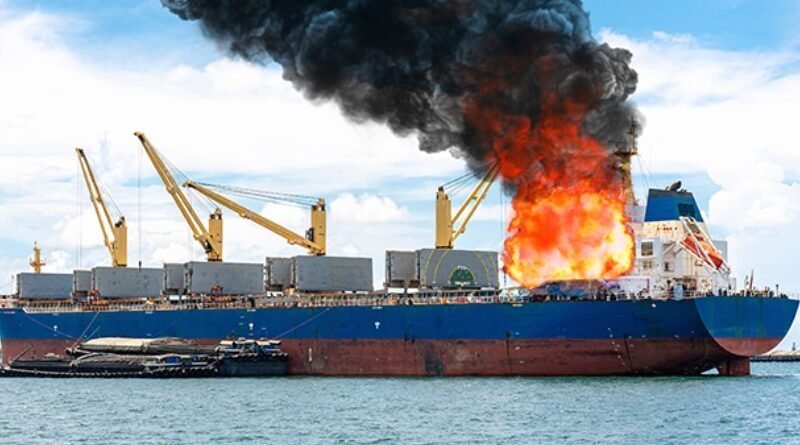
US Bill Targets Lithium-Ion Fire Risks in Container Shipping
Regulatory pressure is growing in the United States and internationally to improve container shipping safety and prevent fires linked to lithium-ion batteries. A new US bill would require visible hazardous-material labels on containers carrying lithium-ion batteries, including ocean containers moving inland after arriving at US ports.
The Battery Safety Placarding Act, introduced on October 1 by Rep. Harriet Hageman, R-Wyo., comes weeks after an International Maritime Organization (IMO) subcommittee agreed to advance revisions aimed at reducing fires at sea caused by lithium-ion batteries in shipping containers. The move highlights growing concerns over maritime safety, dangerous goods transportation, cargo risks, and supply chain security.
US Bill Would Require Visible Battery Placards
According to a draft of the legislation, the bill would require an external placard on containers, vehicles and rail cars transporting lithium-ion batteries.
Hageman said clear identification of hazardous materials is important for law enforcement officers, first responders and the traveling public. She pointed to existing requirements for explosives, flammable liquids and toxic substances, arguing that lithium-ion batteries should also be visibly identified because of the risks they can pose during transportation.

The legislation comes as the lithium-ion battery market has expanded by more than 20% over the past two years to an estimated $150 billion industry. With batteries now transported through almost every major mode of transportation, a series of significant fires has increased attention on battery safety and transportation regulations.
IMO and Shipping Industry Face Similar Safety Concerns
The US initiative echoes concerns raised within the international shipping industry. The World Shipping Council (WSC) has been involved in efforts at the IMO to address what it considers a regulatory gap involving lithium-ion batteries transported in containers.
WSC president and CEO Joe Kramek previously noted that a container can carry thousands of lithium batteries without necessarily being declared as dangerous goods. He argued that an exemption covering batteries contained in electronic devices was originally intended to simplify the transportation of individual devices with small batteries, rather than allow entire container loads to remain unidentified.
The issue is particularly significant for container shipping, where cargo can move through several stages and transport modes before reaching its final destination.
Inland Movement of Imported Ocean Containers Included
Hageman’s office confirmed that the bill’s reference to “freight containers” would include imported ocean containers moving from US ports to inland destinations.
The proposed requirement would make the placard clearly visible from all sides of the container and identifiable by law enforcement and first responders. Such visibility would provide transportation personnel with an immediate indication that lithium-ion batteries are present.
The legislation would also direct the US Secretary of Transportation to establish the quantity of lithium-ion batteries that would trigger the placarding requirement.
That threshold would be determined according to physical characteristics such as battery weight and dimensions, energy capacity, and the different risk profiles associated with batteries throughout the transportation lifecycle.
A New Compliance Challenge for Container Shipping
The proposed US legislation could have implications beyond domestic road and rail transportation because ocean carriers own a significant share of the world’s shipping containers.
For liner companies, the measure could create an additional compliance requirement if US rules develop differently from international standards. The shipping industry has generally favored single global standards for international cargo transportation rather than a patchwork of regional regulations.
At the same time, US legislative and regulatory action could add momentum to ongoing IMO discussions on lithium-ion battery transport, dangerous goods regulations and maritime fire safety.
Why Battery Labeling Matters for Maritime Safety
Lithium-ion batteries can move through complex international supply chains involving vessels, ports, trucks and rail networks. Clear identification is therefore becoming an important part of the wider discussion around cargo safety, emergency response, shipping compliance and supply chain risk management.
The US bill and the parallel IMO work point toward a common regulatory challenge: ensuring that batteries with potential fire risks are properly identified throughout the transportation chain.
If the proposed US requirements advance while IMO reforms are also developed, container shipping companies, cargo owners and logistics operators could face a changing regulatory environment for lithium-ion battery shipments.