Diesel Containers Lost on Antarctic Iceberg Raise Environmental and Marine Insurance Concerns
A significant Antarctic maritime logistics incident involving diesel fuel storage, environmental risk management, marine insurance exposure, and polar shipping operations has emerged after seven shipping containers belonging to Germany’s Neumayer Station III drifted into the Weddell Sea on a fractured iceberg following a severe Antarctic blizzard. The incident has intensified concerns surrounding offshore environmental liability, Arctic diesel spill exposure, climate-related maritime infrastructure vulnerability, and risk management within high-value polar research logistics corridors.
According to a report submitted by German Antarctic authorities and the Alfred Wegener Institute (AWI), the containers had been positioned near the coastline in preparation for a scheduled waste collection operation by a supply vessel servicing the research station. The cargo included one container carrying approximately 9,500 litres of Arctic diesel fuel, four containers containing non-hazardous waste, one generator and fuel container, and a shelter unit for personnel. The event has drawn attention within maritime environmental governance and polar logistics sectors due to the potential implications for marine pollution liability and Antarctic ecosystem protection.
Neumayer Station III is situated on an ice shelf approximately 18 kilometres inland from the sea. Officials stated that prior inspections revealed no visible crevasses, fissures, or structural instability in the ice shelf where the containers had been temporarily stored.
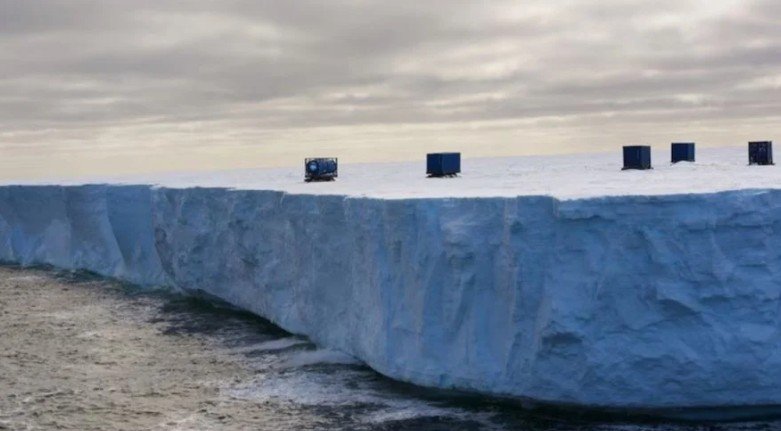
Between January 13 and January 20, the region experienced a powerful blizzard with wind speeds reaching 130 kilometres per hour. When weather conditions improved on January 21, logistics personnel discovered that a large iceberg measuring roughly 500 metres by 300 metres had calved from the ice shelf and drifted into the Weddell Sea with all seven containers still on its surface.
German authorities stated that both the German government and the Alfred Wegener Institute “deeply regret the incident” while confirming that no injuries occurred during the event.
The following day, crew aboard the German research icebreaker RV Polarstern located the drifting iceberg approximately 140 kilometres southeast of the Neumayer ice port. Scientific operations were suspended immediately as the vessel redirected toward the iceberg to evaluate recovery options.
Glaciologists conducted a structural assessment of the iceberg before retrieval efforts commenced. The iceberg was estimated to have an overall thickness of 81 metres, including approximately 15 metres above sea level. Following safety evaluations, helicopter teams successfully recovered nearly one tonne of material, including gas cylinders, batteries, and three drums containing roughly 580 litres of Arctic diesel.
However, deteriorating ice stability and the increasing probability of iceberg fragmentation forced authorities to halt salvage operations. Officials concluded that recovering additional cargo would place personnel at unacceptable risk.
Satellite monitoring recorded the iceberg for the final time on February 22. German authorities believe the iceberg likely disintegrated shortly afterward, causing the remaining containers to sink to the seabed.
The report concluded that the four containers carrying household waste and non-hazardous materials would likely have limited direct ecological impact. However, the diesel fuel container presents a substantially greater environmental concern.
Officials stated it is highly probable that the fuel container was either damaged upon entering the ocean or imploded during descent to the seabed, resulting in diesel leakage into the Antarctic marine environment.
The report further noted that Arctic diesel, although lighter and more volatile than heavy fuel oil, may persist in Antarctic waters for extended periods because extremely low temperatures significantly slow bacterial degradation processes in sea ice and seawater.
Authorities acknowledged that the precise ecological consequences cannot yet be fully quantified, as environmental impact will depend heavily on localized marine conditions and ecosystem dynamics within the affected region.
Read: MSC Charters Dutch Heavy-Lift Vessel for Antarctica Mission, Raising U.S. Flagship Concerns
In response to the incident, German Antarctic authorities announced revised safety protocols for future cargo storage and polar logistics operations. Shipping containers will now be stored at least 5,000 metres away from ice shelf edges, while additional glaciological investigations , including ice thickness analysis and structural consistency assessments ,will be incorporated into operational planning between Neumayer Station III and the ice port.
The report was formally presented during the annual Antarctic Treaty Consultative Meeting held in Hiroshima, Japan.