
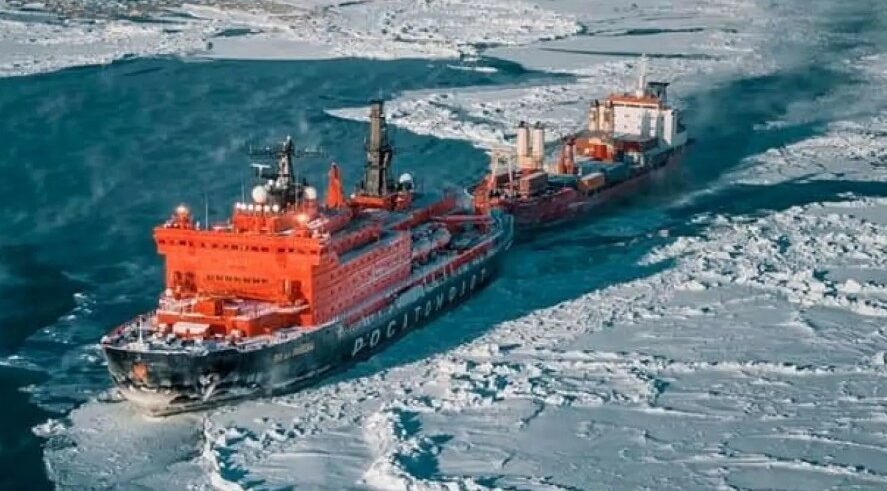
China, Russia and Kazakhstan Advance New Arctic Shipping Route to Boost International Trade and Logistics
China, Russia and Kazakhstan are exploring a major cross-border trade route that could connect Chinese goods with Russian Arctic ports through the Irtysh and Ob rivers, potentially creating a new corridor for international trade, Arctic shipping and logistics. The proposed Ob-Irtysh trade route would provide access to Russian Arctic ports at the base of the Yamal Peninsula, opening a potentially important alternative pathway for the movement of Chinese exports.
The idea is gaining attention as countries seek supply chain resilience, international trade opportunities and alternative shipping routes amid changing geopolitical and economic conditions. However, experts and regional officials face major challenges, including infrastructure costs, seasonal ice, declining water levels, competing demands for water and the long-term effects of climate change.
Ob-Irtysh River Trade Once Carried Millions of Tons
Trade along the Ob-Irtysh river system reached an estimated peak of 9 million tons annually during the 1970s, before collapsing after the dissolution of the Soviet Union in 1991. Kazakhstan and Russia have floated proposals in recent years to revive commercial navigation along the river system, but the concept has gained fresh momentum following China’s interest.
The potential economic and geopolitical benefits are significant for all three countries. Yet transforming the idea into an operational Arctic trade corridor would require substantial investment and could take many years. During that period, global economic and geopolitical conditions could change, potentially affecting the route’s commercial attractiveness.
According to some estimates, the infrastructure investment required could reach tens of billions of dollars. Upgrading waterways, locks, ports and loading facilities would be a long-term undertaking, adding uncertainty to the project’s eventual feasibility.
Kazakhstan Sets Ambitious Irtysh Development Targets
Kazakhstan, a key link in the Ob-Irtysh river system, published an ambitious development plan in 2024 for its section of the river.
The plan seeks to increase river cargo volumes from near zero to 2.5 million tons annually by 2028. It also calls for the construction of dock and loading facilities capable of handling 4 million tons per year, while passenger services are expected to accommodate up to 700,000 people annually as part of efforts to promote tourism.
Some Kazakh experts believe the investment could generate substantial economic returns. Kazinform quoted economist Askat Dyusembayev as saying that billions could be earned by transporting cargo along Kazakhstan’s section of the Irtysh alone.
Ukraine War Adds Strategic Pressure for Russia
The war in Ukraine has added another strategic dimension to Russia’s support for the Ob-Irtysh project.
An Irtysh-Ob connection to the northern seas could potentially provide the Kremlin with another route for obtaining dual-use goods and other supplies needed for its war effort while also supporting the movement of civilian goods. The project is therefore being considered not only from a transportation and commercial perspective but also within a broader geopolitical context.
For Russia, improved access through the Ob-Irtysh system could strengthen connections between Siberian river transport and the Arctic shipping network, although the route would face significant operational and infrastructure challenges.
China Moves Toward a More Favorable Position
China’s position on the proposal appears to be shifting from skepticism toward cautious support.
For Beijing, the proposal also fits into a broader effort to strengthen the resilience and redundancy of its international trade network. While the lowest-cost shipping route has traditionally been central to China’s global trade strategy, growing geopolitical tensions could encourage Beijing to develop alternative transportation corridors.
Arctic Access Could Reduce China’s Shipping Risks
Reliable access to Arctic waters could help China protect its economic interests and reduce its exposure to disruptions affecting major maritime chokepoints.
An alternative connection to Arctic seas could therefore provide Beijing with another option for moving goods internationally, although the practical and economic viability of such a corridor remains uncertain.
Ice and Low Water Levels Pose Major Challenges
Infrastructure is not the only obstacle facing the proposed trade route. Natural conditions could prove equally difficult.
Parts of the Ob River in Russia are ice-bound and impassable for up to six months each year. At the same time, drought and intensive irrigation have contributed to declining water levels in recent years, disrupting barge traffic in Russian regions.
Kazakhstan represents another major chokepoint.
Water levels along the Irtysh in Kazakhstan’s Abai Region have routinely fallen to approximately 105 centimeters, or about 3.5 feet, making the river too shallow for cargo traffic, according to a report published in early 2026 by Rivers without Boundaries, a Kazakhstan-based nonprofit watchdog group.
By comparison, water levels in the Siberian city of Omsk average approximately 2.5 meters, or more than 8 feet, according to the same report.
Kazakh authorities have brought in Russian experts to develop a strategy aimed at maintaining a minimum depth of 1.6 meters along Kazakhstan’s section of the Irtysh.
Hydropower Infrastructure Complicates River Navigation
The Irtysh’s role in hydropower generation adds another layer of complexity to efforts to maintain navigable water levels.
Kazakh experts have argued that the construction of hydropower facilities, particularly the Shulbinskaya hydroelectric power station, contributed to the decline of commercial river traffic during the late Soviet period.
Kazinform reported that poorly constructed locks eventually made parts of the river impassable and that the system effectively ceased functioning during the 1990s.
Restoring navigation would therefore require significant improvements to locks and other infrastructure designed to bypass hydropower facilities.
Elsewhere, a major hydropower project in Russia’s Omsk Region has been suspended because of financing difficulties, according to Rivers without Boundaries in a report published on August 31. No alternative entity has been identified to complete the project, creating further uncertainty over future river traffic in the area.
Xinjiang Water Use Creates a Strategic Dilemma for China
China itself faces a difficult choice if the Ob-Irtysh corridor moves forward.
The Irtysh originates in the Altai Mountains in western China’s Xinjiang Province, where the river’s water is important for agriculture in the region’s arid environment.
China has constructed dams and diverted substantial volumes of Irtysh water to support irrigation in Xinjiang. Over the past 15 years, the flow of water from China into Kazakhstan through the Irtysh has reportedly declined by 2.1 cubic kilometers annually, representing a 22 percent reduction in estimated volume.
That creates a fundamental challenge for the proposed international trade corridor.
For the Ob-Irtysh route to become commercially viable, China may ultimately have to reconsider aspects of its water-use policies in Xinjiang. Balancing agricultural water demand, hydropower requirements, environmental considerations and international river navigation could become one of the most difficult issues surrounding the project.
A Strategic Vision Facing Practical Barriers
The proposed Ob-Irtysh corridor illustrates the growing importance of alternative trade routes in an increasingly fragmented global economy. For China, Russia and Kazakhstan, connecting the river system to Arctic ports could create new opportunities for international logistics, regional trade and Arctic maritime connectivity.
However, the project’s strategic appeal does not automatically translate into commercial feasibility. Billions of dollars in infrastructure investment, seasonal ice, inadequate river depths, hydropower infrastructure and competing water demands could all delay or constrain development.
The most fundamental question may ultimately be whether the three countries can coordinate their competing economic, environmental and geopolitical interests. Without reliable water levels, modern navigation infrastructure and sustained investment, the vision of a major Ob-Irtysh gateway to the Arctic could remain a long-term proposal rather than a fully operational trade corridor.
For now, the renewed interest from China, Russia and Kazakhstan signals that the Ob-Irtysh river system is once again being viewed as a potentially strategic component of Eurasian and Arctic trade.