Bangladesh Joins Three Key IMO Conventions to Strengthen Maritime Safety, Oil Spill Liability and Blue Economy Growth
Bangladesh has taken a major step toward strengthening its maritime governance by joining three important International Maritime Organization (IMO) conventions, reinforcing the country’s legal framework for maritime safety, oil pollution liability, bunker fuel spill compensation and shipwreck removal. The move is expected to align Bangladesh’s maritime regulations with international standards while supporting sustainable shipping and the blue economy.
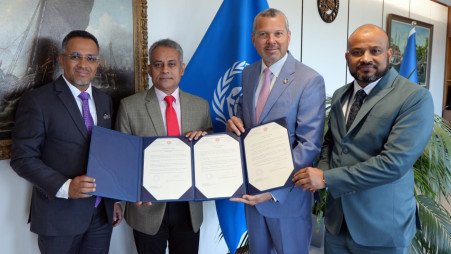
The Government of Bangladesh has officially deposited its instruments of accession to the International Convention on Civil Liability for Oil Pollution Damage, 1969 (as amended by the 1992 Protocol), the International Convention on Civil Liability for Bunker Oil Pollution Damage, 2001, and the Nairobi International Convention on the Removal of Wrecks, 2007.
The instruments were formally presented to IMO Secretary-General Arsenio Dominguez at the IMO headquarters in London. The ceremony was attended by Shipping Minister Shaikh Rabiul Alam, Department of Shipping (DoS) Director General Commodore Md Shafiul Bari, and Bangladesh’s Acting High Commissioner to the United Kingdom M Nazrul Islam.
The accession marks a significant milestone in Bangladesh’s efforts to modernize its maritime legal framework and strengthen its capacity to respond to oil pollution incidents, bunker fuel contamination and hazardous shipwrecks that threaten navigation, coastal communities and marine ecosystems.
Maritime trade expert and Bangladesh Merchant Marine Officers Association President Captain Anam Chowdhury welcomed the government’s decision, noting that Bangladesh should have adopted these conventions much earlier. He explained that the agreements establish internationally recognized liability and compensation mechanisms while requiring shipowners to maintain insurance or other financial security to cover potential pollution and wreck removal claims.
According to Captain Chowdhury, the Civil Liability Convention addresses pollution caused by persistent oil transported in bulk by sea, the Bunker Convention covers pollution resulting from ships’ fuel, while the Nairobi Convention provides a legal framework for locating, marking and removing shipwrecks that pose risks to navigation, coastal safety and the marine environment.
Officials from the Department of Shipping said the conventions will significantly improve Bangladesh’s ability to respond to maritime accidents, strengthen marine environmental protection and provide greater legal certainty in compensation claims arising from pollution and wreck-related incidents.
The treaty accessions are part of a broader maritime reform programme being implemented under the leadership of Director General Commodore Md Shafiul Bari, aimed at modernizing Bangladesh’s maritime administration and ensuring compliance with international shipping standards.
Commodore Bari emphasized that the move carries particular importance as hundreds of commercial vessels transit through Bangladesh’s waters or call at its ports each year. He noted that oil spills, bunker fuel pollution and shipwrecks have the potential to disrupt shipping operations, damage marine biodiversity and negatively affect the livelihoods of coastal communities.
He also highlighted the commercial advantages for Bangladesh’s shipping sector, explaining that Bangladeshi-flagged vessels will now be able to obtain convention-related certificates directly through the country’s maritime administration instead of relying on foreign authorities. This is expected to reduce costs, minimize delays, lower foreign exchange expenditure and improve confidence among charterers, insurers and port authorities.
Alongside the legal reforms, Bangladesh is accelerating the digital transformation of its maritime administration. Departmental records indicate that nearly 80% of the Department of Shipping’s services have been automated, improving transparency, reducing processing times and making public services more accessible.
The department has introduced several digital platforms, including the Personnel Management Information System (PMIS), Document Management System (DMS) and Asset Management System (AMS). It has also implemented digital identity cards, electronic certification and digital service book management for seafarers to streamline maritime administration.
In addition, Bangladesh has launched Lighter Vessel Management Software to digitize the management of lighter vessels transporting imported cargo from seaports through inland waterways. Officials believe the system will improve transparency in vessel allocation while simplifying administrative procedures.
The Department of Shipping is also developing a comprehensive national vessel census and integrated maritime database to strengthen vessel registration, regulatory enforcement, safety monitoring and maritime planning. The initiative is expected to help identify unregistered or non-compliant vessels while reducing disputes related to ownership, documentation and vessel fitness certification.
To further improve maritime emergency preparedness, the department has operationalized the Joint Maritime Rescue Coordination Centre, which coordinates search and rescue operations for ships and individuals in distress across Bangladesh’s coastal and maritime zones.
Regulatory enforcement has also intensified. During the 2024–25 fiscal year, Department of Shipping inspectors examined 9,800 vessels, filed 3,120 cases involving violations of shipping laws and supported 48 mobile court operations in inland river port areas, resulting in fines totaling approximately Tk65.6 lakh.
Bangladesh has also expanded its international maritime cooperation through a mutual recognition agreement with the United Kingdom covering maritime education and certification. The agreement is expected to create additional employment opportunities for qualified Bangladeshi seafarers aboard UK-registered vessels.
According to the 2024 United Nations Conference on Trade and Development (UNCTAD) report, Bangladesh ranked 35th among the world’s ship-owning nations, reflecting the country’s growing presence in global shipping.
Officials said the government’s ongoing reform agenda combines international legal commitments, digital transformation, stronger vessel inspections and improved regulatory oversight to support Bangladesh’s expanding maritime trade and blue economy. They added that the next priority will be ensuring the effective implementation of the newly adopted conventions through robust certification systems, insurance verification, regulatory enforcement and close coordination among government agencies, ports, shipowners and environmental authorities.
Successful implementation, officials believe, will enhance maritime safety, reduce commercial risks and further strengthen Bangladesh’s reputation as a responsible and internationally compliant maritime nation.