
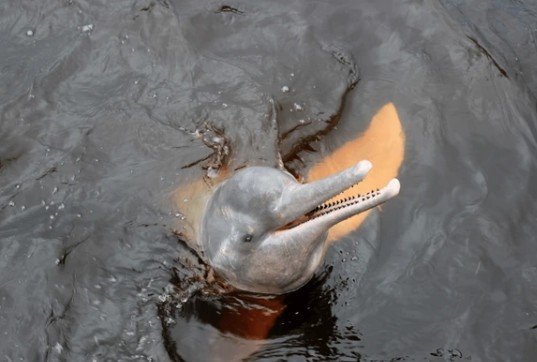
Indus River Dolphin Population Rebounds to Nearly 2,000 in Pakistan
Pakistan’s Indus River Dolphin, one of the world’s rarest freshwater cetaceans, has made a remarkable recovery from the brink of extinction, with the latest full census recording 1,987 dolphins, compared to just 132 individuals counted across the Indus River system during the species’ lowest recorded population period. The recovery marks one of the most significant wildlife conservation achievements in South Asia, despite increasing pressure from irrigation infrastructure, industrial activity, and declining river flows. The Indus River, heavily laden with silt, creates extremely low underwater visibility, leading the dolphin to evolve without functional vision and instead rely on sophisticated echolocation to navigate and hunt fish.
The greatest threat to the species emerged during the twentieth century when the construction of numerous barrages transformed the once-continuous Indus River into fragmented sections supporting Pakistan’s irrigation network. Although these engineering projects significantly boosted agricultural productivity, they isolated dolphin populations by preventing upstream movement. As a result, the species’ habitat contracted dramatically from approximately 2,175 miles (3,500 km) of river to around 430 miles (690 km). Dolphins swept into irrigation canals frequently became stranded in shrinking waterways, while hunting for oil and meat further accelerated population decline, pushing the species close to extinction by the early 1970s.
Conservation efforts gradually reversed this trend through a combination of legal protection, habitat management, and community participation. Surveys documented approximately 429 dolphins in the late 1980s, followed by around 1,200 during the first modern range-wide census, increasing to approximately 1,550, then 1,665, before reaching 1,987 in the most recent full survey. Most of the surviving population now inhabits the protected stretch of river between the Guddu and Sukkur barrages, an area designated as a protected reserve and later recognized internationally as a wetland of importance. Local fishermen and nearby communities have played a critical role by reporting stranded dolphins in irrigation canals, enabling wildlife rescue teams to safely relocate more than one hundred dolphins back into the main river over the past three decades.
Despite this conservation success, significant risks remain. Nearly the entire global population is concentrated within a single section of the Indus River, making the species highly vulnerable to pollution incidents, prolonged droughts, industrial discharge, accidental entanglement in fishing nets, and reduced environmental flows caused by increasing water demand. Rescue operations continue every irrigation season as dolphins are still swept into canals, highlighting that long-term conservation requires continuous management rather than one-time intervention. Scientific taxonomic studies have also confirmed that the Indus River Dolphin is a distinct species separate from the Ganges River Dolphin based on skull characteristics, tooth counts, and genetic evidence, making Pakistan solely responsible for safeguarding this globally unique freshwater mammal.
From an environmental governance perspective, the recovery of the Indus River Dolphin demonstrates that infrastructure development and biodiversity conservation do not necessarily have to remain opposing objectives when supported by science-based management, protected habitats, and sustained community engagement. While Pakistan’s irrigation system remains indispensable for national food security, the dolphin’s gradual rebound illustrates how adaptive conservation policies, continuous wildlife monitoring, and local participation can reduce ecological impacts. However, maintaining this positive trajectory will depend on balancing future water resource development with environmental flow protection, pollution control, and long-term ecosystem restoration, ensuring that one of the world’s most extraordinary freshwater species continues to survive in its only natural habitat.