China and South Korea Release Millions of Fish Fry into Yellow Sea to Boost Sustainable Fisheries and Marine Economy
China and South Korea have strengthened their commitment to sustainable fisheries management and marine ecosystem conservation by jointly releasing millions of fish fry and juvenile aquatic species into the Yellow Sea, a vital fishing ground shared by both nations.
The latest China-South Korea fishery resource enhancement initiative took place on Tuesday, with coordinated release ceremonies held simultaneously in Yantai, Shandong Province, and Incheon, South Korea. The effort is designed to restore depleted fish stocks, protect marine biodiversity, and support the long-term livelihoods of fishing communities that depend on the Yellow Sea.
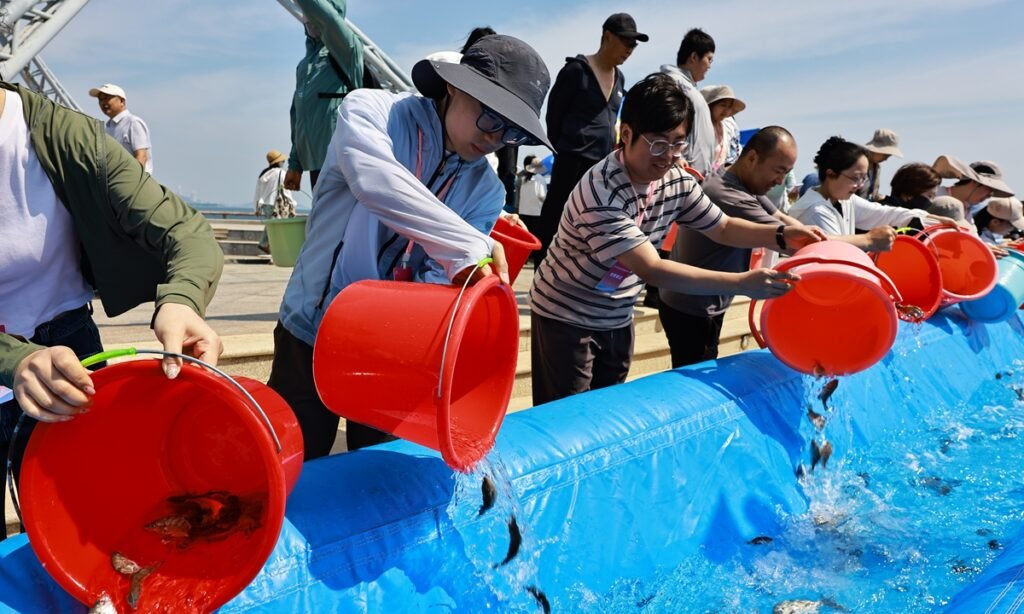
During the event in Yantai, 330,000 greenfin horse-faced filefish juveniles were released at the city’s iconic Tianma Trestles. The release formed part of the seventh China-South Korea Joint Stock Enhancement and Release of Fishery Resources program, which has been conducted annually since its launch in 2018, except during interruptions caused by the COVID-19 pandemic.
This year’s coordinated conservation effort saw South Korea release 4.29 million aquatic fry and juveniles, including commercially valuable species such as small yellow croaker, red seabream, and swimming crab, into the Yellow Sea from Incheon. At the same time, China released 3 million aquatic juveniles in Yantai, including greenfin horse-faced filefish, blackhead seabream, and swimming crab.
The Yellow Sea remains one of East Asia’s most important fishing regions and has supported Chinese and South Korean fishermen for generations. Officials say the joint stock enhancement program is aimed at increasing fishery resources, improving the marine ecological environment, and ensuring the sustainable use of shared fish stocks.
Veteran fisherman and boat owner Cui Gang, who has more than 25 years of fishing experience and has operated in the jointly managed waters of the Yellow Sea for over a decade, praised the initiative. According to Cui, the stock enhancement program has contributed significantly to fish stock recovery and helped increase his annual income by approximately 20 to 30 percent.
He noted that commercially valuable species such as greenfin horse-faced filefish and red seabream have become more abundant and larger in size following previous release programs, resulting in stronger market demand and higher profits for fishermen.
Since the signing of the bilateral Fishery Agreement in 2000, China and South Korea have cooperated through the Joint Committee on Fisheries on fishing access arrangements, fishery resource surveys, and fisheries law enforcement. Authorities say the collaboration has produced substantial results in managing shared marine resources.
According to the Yellow Sea Fisheries Research Institute (YSFRI) of the Chinese Academy of Fishery Sciences, the primary objective of the release program is to conserve fishery resources while protecting the ecological health of the Yellow Sea. The species selected for release are migratory, commercially valuable, and shared by both countries. These include small yellow croaker, blackhead seabream, greenfin horse-faced filefish, red seabream, and swimming crab.
Experts from both nations coordinate closely on the selection of species, release quantities, timing, locations, and scientific monitoring methods. Through expert consultations, technical exchanges, fisheries surveys, and data sharing, both sides work to develop scientifically sound and operationally practical release strategies.
Researchers acknowledge that differences occasionally arise regarding priority species, size standards for released juveniles, and evaluation methodologies. However, these issues are addressed through expert meetings, technical discussions, joint surveys, and ongoing cooperation.
Particular attention has recently been given to swimming crab resource enhancement programs. Scientists from both countries have exchanged knowledge on molecular marker technologies used to evaluate stock enhancement effectiveness, helping improve future fishery management plans.
According to institute experts, South Korea recorded a notable increase in swimming crab catches in the Yellow Sea during autumn 2025, while Total Allowable Catch (TAC) levels remained relatively high. Although long-term monitoring remains necessary, researchers believe stock enhancement activities have played an important role in improving resource conditions and supporting recovery trends.
Wang Hongliang, head of the Yantai Marine and Fishery Supervision and Inspection Detachment, said Yantai’s release plan for this year’s event included 3 million aquatic juveniles comprising greenfin horse-faced filefish, blackhead seabream, and swimming crab.
He emphasized that the initiative is expected to generate economic, ecological, and social benefits by increasing marine fishery resources, supporting fishermen’s incomes, protecting marine biodiversity, and maintaining ecological balance within the Yellow Sea ecosystem. The program also aims to strengthen public awareness of marine conservation and encourage broader participation in protecting ocean resources.
Since the launch of the joint initiative in 2018, China and South Korea have collectively released approximately 18.75 million aquatic fry and juveniles into the Yellow Sea. According to China’s Ministry of Agriculture and Rural Affairs, these efforts have made a positive contribution to restoring commercial fishery resources, improving the marine environment, and increasing earnings for fishermen in both countries.
Read: China’s Yangtze River Fishing Ban Sparks Comeback of Endangered Finless Porpoises
Qu Jiangbo, president of the Yantai Aquatic Biological Resources Conservation Association and legal representative of Tianyuan Aquaculture, said his company was responsible for maintaining and caring for the fry and juveniles released during this year’s program.
“The fish we release can swim into South Korean waters, while fish released by South Korea can also enter our waters,” Qu explained. “That is why both sides conduct simultaneous releases to increase fishery resources and support fishermen on both sides.”
As global concerns over overfishing, marine biodiversity loss, and sustainable seafood production continue to grow, the China-South Korea partnership in the Yellow Sea is increasingly being viewed as a model for international fisheries cooperation, marine resource restoration, and blue economy development.